Reviewed by Yoan Guyon, Managing Director at gbc engineers
Most data centers running today were not designed for liquid cooling. They were built for 5 to 15 kW per rack, standard CRAC units, and air-cooled servers. AI infrastructure changed the load profile quickly. Operators who invested in functional facilities now face a decision with no single clean answer: retrofit for liquid cooling, or start from scratch with a purpose-built design.
In this article, gbc engineers investigates the retrofit versus new build decision for liquid cooling: what retrofitting actually involves, where it works, where it fails, and what structural and operational mistakes to avoid before they become program problems.
Why the retrofit decision is being forced now
Uptime Institute's 2024 Global Data Center Survey shows average rack power density climbing, though the industry average remains below 8 kW per rack for most facilities. AI and HPC deployments are the outlier: NVIDIA H100 and H200 GPU servers commonly reach 10 to 12 kW per server. A single 42U rack running a full AI training load can push 60 to 100 kW.
ASHRAE TC 9.9 notes that air cooling becomes harder to engineer reliably as rack densities and server airflow requirements increase, with practical difficulty typically emerging above 30 kW per rack.
For operators with existing facilities, this creates a genuine capital dilemma. Decommissioning a recently depreciated building to start fresh is expensive and often unnecessary. But retrofitting an air-cooled data center for liquid cooling is not a simple equipment swap. It involves structural loads, pipe routing, facility water systems, power distribution, and maintenance model changes that must be coordinated early.
The EU Energy Efficiency Directive and Commission Delegated Regulation (EU) 2024/1364 add another factor. Operators above the relevant reporting threshold must report defined energy performance indicators, including PUE and water use efficiency. For facilities that cannot reach competitive PUE targets with air cooling at today's rack densities, liquid cooling is the practical response to those reporting obligations in high-density AI and HPC zones.
Read more: Can You Really Achieve PUE Below 1.2? Building Physics Meets Data Center Cooling Design
Three liquid cooling retrofit approaches
Retrofitting liquid cooling into an existing air-cooled data center takes different forms depending on the technology chosen, how much of the facility needs to change, and whether the work happens alongside live operations.
Rear-Door Heat Exchangers (RDHx)
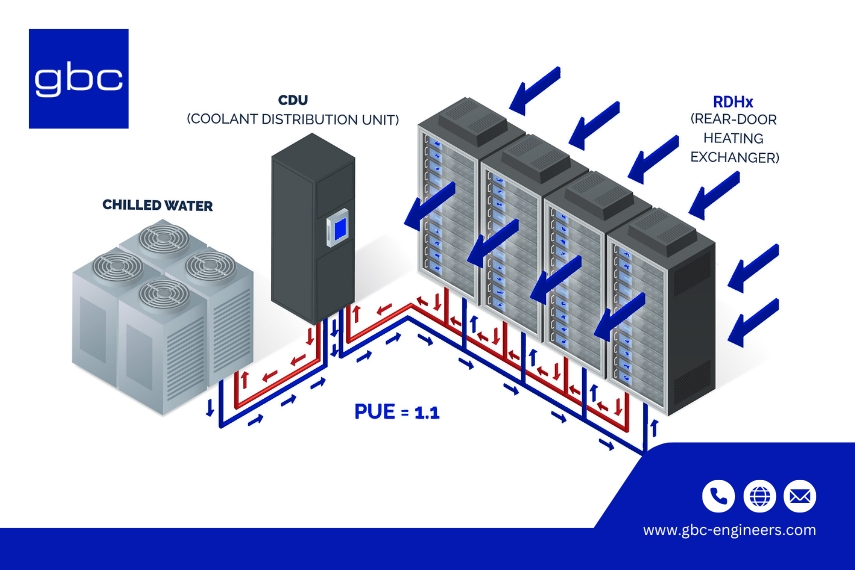
RDHx units attach to the back of existing racks and cool the air exhaust before it re-enters the room. They require no server modifications, use existing rack enclosures, and connect to a facility water loop. RDHx is the most conservative retrofit path, well suited for rack densities between 10 and 25 kW where full liquid cooling is not justified but air systems are struggling under load.
Direct-to-Chip (DTC) cooling
Direct-to-Chip cooling places cold plates directly on CPU, GPU, or accelerator packages. Coolant flows through the plate into a Coolant Distribution Unit (CDU), which manages temperature, pressure, and flow. DTC handles rack densities from 30 kW to above 100 kW and is the most practical liquid cooling retrofit for AI and HPC workloads. It requires OEM-compatible cold plate servers, CDU placement near the rack zone, and pipe routing through the raised floor or overhead.
Immersion cooling
Immersion cooling submerges server boards in dielectric fluid inside tanks. It is the most disruptive retrofit option because it replaces standard racks with tanks, removes servers from conventional enclosures, and changes fluid management entirely. Immersion rarely makes sense as a retrofit unless a dedicated high-density zone is being built with a full structural and systems redesign from the start.
Read more: Direct-to-Chip vs Immersion Cooling: Which Liquid Cooling System Is Right for Your Data Center?
Retrofit vs new build: the key decision factors
The decision is not binary. Most operators land somewhere between a full retrofit and a full new build, because neither extreme fits typical financial and operational constraints.
|
Factor
|
Retrofit
|
New Build
|
|
Upfront capital cost
|
Lower (existing structure reused)
|
Higher (full construction required)
|
|
Time to deployment
|
Faster for phased rollout
|
Longer lead time for construction
|
|
Structural flexibility
|
Limited by existing slab and floor system
|
Full design control from the start
|
|
Rack density ceiling
|
30 to 100+ kW with DTC; constrained for immersion
|
Designed around target density from the start
|
|
Operational disruption
|
High; work around live operations
|
None during construction phase
|
|
PUE potential
|
1.2 to 1.4 achievable with DTC and good design
|
Sub-1.2 achievable with full liquid design
|
|
Long-term scalability
|
Limited by existing building envelope
|
Designed for future density growth
|
|
Risk profile
|
Higher; structural unknowns, live environment
|
Lower; design variables known from the start
|
The structural consequences of retrofitting liquid cooling
This is where gbc engineers can speak from direct project experience. Cooling decisions that look like MEP-only choices consistently create structural consequences that surface late, after the design is committed and the program is under pressure.
Floor loading and CDU weight
CDUs for DTC cooling systems are heavy. A unit handling a 250 to 500 kW cooling loop typically weighs 400 to 800 kg, depending on manufacturer and pump configuration. In raised floor environments, this load often exceeds what floor tile systems and supporting pedestals were originally rated to carry.
Older raised floor systems can approach their load limits quickly when CDU weight, manifold assemblies, and secondary pipework are added together. Manufacturer ratings vary widely; commonly installed systems carry ratings in the 600 to 1,000 kg/m² range, though older or lighter-duty installations may be rated lower.
A structural assessment of the raised floor and the concrete slab beneath it should happen before CDU locations are confirmed in the MEP design, not after.
Slab penetrations and pipe routing
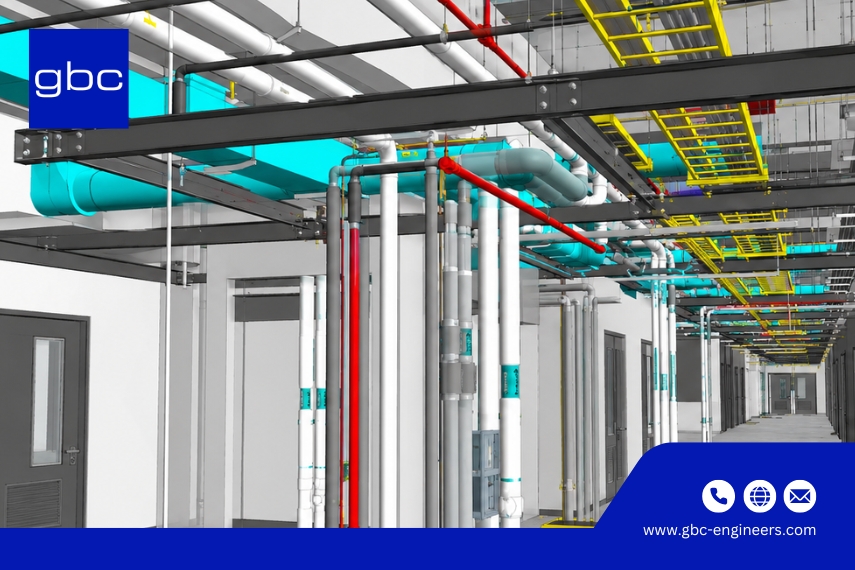
DTC cooling systems need coolant supply and return pipes routed from CDUs to rack manifolds. In buildings with hollow core concrete slabs, these penetrations must be coordinated before the slab is manufactured or during a planned construction window. Cutting through hollow core slabs after the fact risks structural degradation and requires engineering sign-off on each location.
When this coordination happens late, pipe routes end up longer, less efficient, and harder to maintain. In some cases routes run over the top of the raised floor, creating trip hazards and disrupting airflow management.
Plant room sizing
A serious liquid cooling retrofit typically needs more plant room space than the original facility provided. CDUs, secondary water loops, dry coolers, heat exchangers, and buffer tanks all need accessible, maintainable space. When the plant room was sized only for air handling units, finding room for liquid cooling infrastructure often means repurposing other areas or adding plant space externally.
From a structural standpoint, gbc engineers has found that the most common late-stage issue on retrofit projects is not the cooling equipment itself but the infrastructure around it: CDU foundations, pipe support brackets, penetration coordination, and plant room floor loading are often not reviewed by the structural engineer until the MEP design is already advanced.
Liquid cooling retrofit risks operators discover too late
Several risks on liquid cooling retrofit projects are not visible at the decision stage but consistently cause program and cost problems once construction is underway:
- Raised floor systems rated for standard server racks that cannot carry CDU weight or manifold assemblies, discovered only after CDU locations are committed in the MEP design.
- Slab penetrations for coolant pipework not coordinated with the structural engineer, resulting in field cuts that compromise structural integrity or force pipe route redesigns on the critical path.
- Facility water systems not designed for the flow rates and pressures that DTC cooling requires, causing pressure fluctuations that affect cooling performance across the hall.
- Leak detection gaps in areas originally designed for air systems, where water sensors were not required and are not installed at critical manifold and connection points.
- Server OEM warranty conditions requiring specific cold plate configurations, fluid types, or coolant temperatures, not reviewed until hardware is already purchased.
- Power distribution capacity that cannot support full CDU load in zones where the original power design assumed air-cooled rack densities.
Read more: Air vs Liquid Cooling in Data Centers: When Should You Make the Switch?
What makes a liquid cooling retrofit fail
Each of the risks above traces back to a decision made, or not made, at concept stage. These are the planning failures that allow those field discoveries to happen.
- Specifying CDU locations without a structural review. The raised floor and slab need to be assessed against CDU weight before MEP design is locked. Once positions are committed, any structural limitation becomes a redesign cost.
- Not coordinating slab penetrations early. Hollow core slabs cannot be modified after construction, and unconfirmed penetration locations carry redesign risk on the critical path.
- Overlooking facility water system capacity. Existing chilled water loops and pump capacity may not support liquid cooling flow requirements. This typically surfaces in detailed design, not at concept stage.
- No leak detection plan. Every coolant connection in a live data hall is a potential failure point. Treat it as a design requirement, not an afterthought.
- Skipping OEM compatibility checks. Not all servers support cold plates from all vendors. For immersion cooling, most OEM warranty conditions require specific fluid types and operating procedures.
- Air-cooled electrical designs do not account for CDU load. Without an early check, modifications to distribution boards, cabling, and UPS are often discovered only after the CDU specification is locked.
Practical recommendations for a liquid cooling retrofit
- Commission a structural assessment at concept stage. The structural engineer should review raised floor capacity, slab penetrations, and plant room loading before CDU locations are confirmed. This is the review most often deferred and most often regretted.
- Model three scenarios before committing. Full retrofit, a hybrid liquid-cooled zone, and a phased new build each carry different risk profiles. For most operators, the hybrid approach delivers a better outcome.
- Separate zones by density from day one. Air-cooled and liquid-cooled zones have different structural requirements and system designs. Mixing them in a single undifferentiated data hall creates coordination problems later.
- Define the facility water system scope early. DTC cooling flow rates may not match what the existing chilled water loop was designed for. Confirming this at concept stage avoids late-stage replumbing.
- Plan for liquid cooling infrastructure even if you're not deploying it yet. Installing structural capacity, pipe routes, and power capacity during an initial build costs far less than retrofitting the same infrastructure later.
Conclusion
Retrofitting a data center for liquid cooling is achievable, but it is not a straightforward equipment upgrade. The structural consequences of adding CDUs, pipe routes, and coolant infrastructure to a building designed for air-cooled servers must be addressed before the MEP design is committed. gbc engineers consistently finds that late structural coordination is the main source of program risk on liquid cooling retrofit projects.
The right path depends on the building, the density target, and the timeline. For most operators, a hybrid approach, a dedicated liquid-cooled zone within or adjacent to the existing facility, delivers the best outcome. The decision should start with a coordinated structural and MEP assessment at concept stage, not the equipment specification.
Frequently asked questions
Is retrofitting an existing data center for liquid cooling effective?
Yes, under the right conditions. Retrofitting works well when the facility has adequate floor loading capacity, accessible plant room space, and a rack density target in the 30 to 100 kW range suited to Direct-to-Chip cooling. For consistently higher densities or facilities with significant structural constraints, a purpose-built facility is often more cost-effective over the full lifecycle.
What are the main disadvantages of retrofitting for liquid cooling?
The main disadvantages are structural constraints, program risk, and operational disruption. Existing floors may not carry CDU weight, slab penetrations may conflict with structural elements, and plant rooms may not have space for secondary cooling infrastructure. Retrofitting also means working around live operations, which adds complexity to installation, commissioning, and testing.
What are the biggest risks of a liquid cooling retrofit?
The most significant risks are uncoordinated structural work, insufficient facility water system capacity, gaps in leak detection coverage, and OEM warranty conditions not reviewed before hardware procurement. Late discovery of any creates redesign cost and program delay, with structural risks proving especially acute once MEP design is committed.
What are the most common mistakes when retrofitting a data center for liquid cooling?
The most common mistakes are specifying CDU locations without a structural review, failing to coordinate pipe penetrations through hollow core slabs before construction, and not checking facility water system capacity against liquid cooling flow requirements. Also common: installing liquid cooling infrastructure without a leak detection plan, and not confirming OEM server compatibility and warranty terms before selecting a cooling technology.
When does building new make more sense than retrofitting for liquid cooling?
A new build makes more sense when target rack density is consistently above 100 kW, when immersion cooling is planned from the start, when the existing building has significant structural limitations, or when the operational lifecycle of the facility is already short. New build also becomes more attractive when the full scope of structural modifications, system upgrades, and operational disruption approaches the cost of a purpose-designed facility.
What is the difference between Direct-to-Chip and Rear-Door Heat Exchangers for a liquid cooling retrofit?
RDHx units are the less disruptive option. They attach to existing racks without server modification and reduce exhaust air temperatures but are limited to lower density ranges. Direct-to-Chip goes further: cold plates attach directly to processors and a full coolant loop with CDUs is installed. DTC supports much higher rack densities and significantly better PUE, but requires more infrastructure change, a careful structural review, and compatible server hardware.
What structural checks are needed before a liquid cooling retrofit?
The structural engineer should assess raised floor load capacity against CDU and manifold weights, concrete slab penetration feasibility for coolant pipe routes, plant room floor loading for CDUs and secondary water equipment, and any vibration considerations for heavy cooling infrastructure. This review should happen at concept stage, before MEP design is advanced and before equipment specifications are fixed.
|
About us
gbc engineers
is an international engineering consultancy with offices in Germany, Poland, and South East Asia, having delivered 500+ projects worldwide. We provide services in structural engineering, data center design, infrastructure and bridge engineering, BIM & Scan-to-BIM, and construction management. Combining German engineering quality with international expertise, we achieve sustainable, safe, and efficient solutions for our clients.
|