Reviewed by Yoan Guyon, Managing Director at gbc engineers
The rapid growth of AI, cloud computing, and digital services is driving a new wave of data center development worldwide. As computing power increases, so does heat generation, making data center cooling one of the most critical factors in facility performance.
Modern data center cooling systems must do more than maintain acceptable temperatures. From conventional air-based solutions to advanced liquid and hybrid approaches, the choice of data center cooling technologies can significantly influence operational reliability, cost efficiency, and future scalability.
In this article, gbc engineers provides a practical overview of data center cooling, including key system types, core engineering principles, and emerging innovations shaping the next generation of data center design.
What is data center cooling?
Data center cooling is the combination of systems, technologies, and operational strategies used to maintain stable thermal conditions inside a data center. By controlling temperature, humidity, and airflow, it helps protect critical IT equipment, support reliable performance, and reduce the risk of overheating and downtime.
Read more: Data Center Cooling Systems: Key Challenges, Solutions, and the Cooling Systems’ Impact on Structure
Why is data center cooling important?
Data center cooling is important because IT and electrical equipment must operate within controlled thermal conditions to perform reliably. Excess heat and poor humidity control can lead to performance degradation, equipment damage, higher operating costs, and unplanned downtime.
Research published by Elsevier also suggests that effective cooling optimization can improve not only thermal control, but also overall data center performance and energy efficiency.
As high-density computing environments become more common, the choice of cooling methods plays an increasingly important role in supporting operational resilience, energy efficiency, and long-term asset performance.
What are data center cooling systems and methods?
Data center cooling methods describe the main approaches used to remove heat from IT equipment, while data center cooling systems refer to the specific technologies or equipment that apply those approaches in practice.
Together, they form the basis of effective data center cooling, helping maintain stable operating conditions, protect critical infrastructure, and support reliable facility performance.
The main types of data center cooling include air cooling, liquid cooling, free cooling, evaporative cooling, and hybrid cooling:
- Air cooling uses conditioned air to absorb and remove heat from servers. Common data center cooling systems within this method include CRAC units, CRAH units, raised-floor air distribution, and hot aisle/cold aisle containment. It remains the most widely used approach in conventional facilities, although its effectiveness becomes more limited as rack densities increase.
- Liquid cooling uses water or coolant to transfer heat more efficiently than air. Common data center cooling technologies within this category include the chilled water system, direct-to-chip cooling, and immersion cooling. This method is increasingly important for AI, HPC, and other high-density workloads that generate greater thermal loads.
- Free cooling reduces the need for mechanical cooling by using naturally cool outdoor air or water. It is commonly supported by airside or waterside economizer systems. Its main advantage is improved energy efficiency, although its suitability depends heavily on local climate conditions.
- Evaporative cooling removes heat through water evaporation and can improve cooling efficiency in the right environment. It is often used as a supplementary solution rather than a standalone strategy, especially where humidity levels and water availability must be carefully considered.
- Hybrid cooling combines two or more methods within one facility. For example, a data center may use air cooling for general room conditions and liquid cooling for high-density racks. This approach offers greater flexibility and is becoming more common in modern data center cooling systems designed for mixed workloads and future expansion.
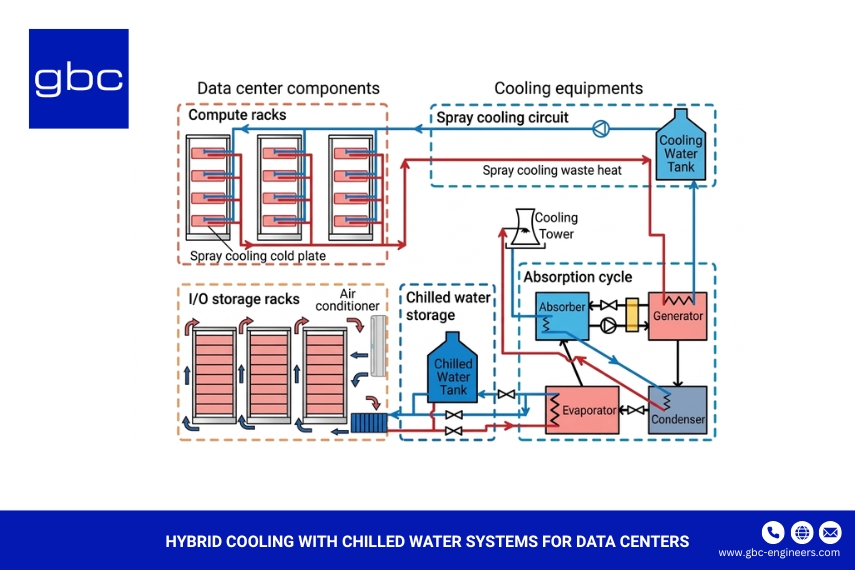
Overall, the best data center cooling systems and methods depend on workload density, facility design, local climate, and energy-efficiency goals. Rather than relying on a single solution, the most effective approach is one that responds to the facility’s technical requirements and long-term performance needs.
How does data center cooling design and optimization improve performance?
Effective data center cooling is not only about selecting the right equipment. It also depends on how cooling is integrated into the overall facility design and how well the system is optimized during operation.
A good data center cooling design helps improve thermal performance, reduce energy use, support uptime, and prepare the facility for changing workload demands:
| Design factor |
Why it matters |
| Airflow management |
Helps direct cooling to critical equipment, reduce hot spots, and improve overall thermal stability. |
| Hot aisle/cold aisle containment |
Prevents mixing between supply air and exhaust air, improving cooling efficiency and system control. |
| Temperature and humidity control |
Maintains safe operating conditions and helps protect IT equipment from overheating, condensation, or static-related damage. |
| Leak prevention and sealing |
Reduces cooling losses around cable openings, raised floors, and other weak points that can affect performance. |
| Monitoring and automation |
Supports early detection of thermal issues and enables faster, more precise cooling adjustments. |
| Scalability planning |
Ensures the cooling design can support future rack densities, changing workloads, and long-term facility growth. |
| Liquid cooling integration |
Becomes increasingly important in high-density environments where air cooling alone may no longer be sufficient. |
| Energy-efficiency optimization |
Helps lower operating costs and supports sustainability goals by improving how cooling resources are used. |
In practice, strong data center cooling performance depends not only on the system selected, but also on how effectively cooling is designed, monitored, and optimized over time.
The importance of energy efficiency in data center cooling
According to MIT Sloan School of Management, data center growth could account for nearly 21% of global energy demand by 2030. This makes energy efficiency a central issue in data center cooling, especially as hyperscale facilities and AI-driven workloads continue to increase thermal loads.
Effective improvement starts with well-maintained infrastructure, efficient IT equipment, and optimized system controls. More advanced solutions such as free cooling and liquid cooling can further increase efficiency by reducing dependence on conventional mechanical cooling.
Read more: How a Green Cooling Data Center Reduces Energy Consumption
How to save costs and avoid overcooling in data centers
Overcooling occurs when a data center is maintained below the temperature required for safe equipment operation.
To reduce overcooling:
- Assess temperature, humidity, and airflow at rack and room level
- Confirm that containment measures are functioning effectively
- Identify and seal cooling losses around floors, openings, and gaps
- Verify blanking panels and proper cable organization
- Correct airflow imbalances caused by layout or obstructions
- Adjust cooling setpoints step by step, not all at once
- Validate each change through follow-up monitoring
- Base optimization on actual operating conditions, not caution alone
6 must-know innovations in data center cooling technology
As thermal loads continue to rise, data center cooling technology is evolving beyond conventional air-based systems. New innovations are helping operators improve heat removal, support higher rack densities, and reduce energy use in increasingly demanding environments.
1. Direct-to-chip cooling
Direct-to-chip cooling delivers liquid coolant directly to high-heat components such as CPUs and GPUs. By removing heat at the source, it offers far greater thermal efficiency than traditional air cooling and is becoming a key solution for AI and HPC environments.
2. Two-phase immersion cooling
In two-phase immersion cooling, IT components are submerged in a dielectric fluid that absorbs heat and evaporates as temperatures rise. This approach supports extremely high computing densities, reduces the need for fans, and can improve both cooling efficiency and equipment reliability.
3. Geothermal cooling
Geothermal cooling uses the ground as a heat sink instead of relying only on conventional outdoor heat rejection. While less common in data centers, it offers long-term potential for lower operating costs and improved sustainability where site conditions make it viable.
4. Microchannel liquid cooling
Microchannel liquid cooling uses compact cold plates with very small internal channels to increase heat transfer across a larger surface area. This allows more precise cooling of high-performance components while reducing equipment size and improving space efficiency.
5. Microconvective liquid cooling
Microconvective liquid cooling uses small fluid jets to remove heat directly at chip level. Designed for very dense compute applications, it improves heat transfer performance and can help reduce both energy and water consumption in advanced data center environments.
6. Calibrated vector cooling (CVC)
Calibrated vector cooling (CVC) directs cooled air precisely to the hottest parts of a server or computing system. By targeting thermal hotspots more accurately, it improves airflow efficiency and reduces unnecessary cooling across the wider system.
Up to this point, gbc engineers has introduced the key innovations shaping modern data center cooling. If you are particularly interested in AI, follow the next section on the future of data center cooling technologies.
Data center cooling and AI: The future of data center cooling technologies
The future of data center cooling technologies is being shaped by rising compute density, especially from AI workloads, which is pushing many facilities beyond the practical limits of conventional air cooling. Industry guidance from ASHRAE and reporting from Uptime Institute both point to growing adoption of liquid cooling in next-generation and AI-driven environments.
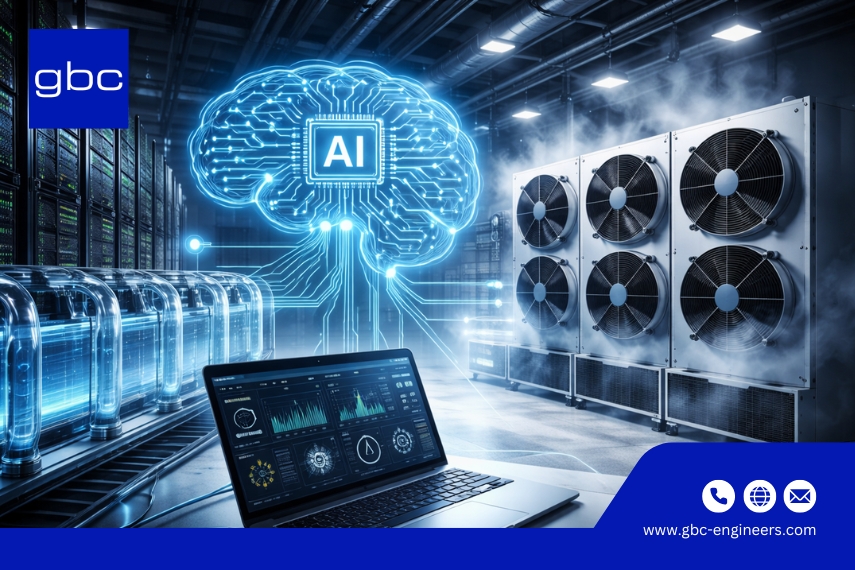
In this shift, AI in data center cooling system is best understood as an optimization layer rather than a standalone cooling solution. By using real-time data on temperature, airflow, and workload behavior, AI can help improve control, reduce overcooling, and identify issues earlier. NREL highlights AI’s value in anomaly detection, predictive maintenance, and operational optimization.
Looking ahead, the industry is likely to rely on a mix of liquid cooling, hybrid cooling, and smarter control systems rather than a single replacement for legacy designs. Sustainability will remain a core driver as well, with the U.S. Department of Energy noting that cooling can account for up to 40% of total data center energy use.
Read more: AI Data Center Design: The Future of Data Center Technology
FAQs about data center cooling systems
Below are a few common questions about data center cooling systems:
1. How does data center cooling work?
Data center cooling removes heat from IT equipment and transfers it out of the data hall through air- or liquid-based systems. Common data center cooling technologies include air cooling, chilled water systems, direct-to-chip cooling, and immersion cooling.
2. What is the best cooling system for a data center?
There is no single answer, because the best data center cooling systems depend on facility size, workload density, location, and efficiency goals. In high-density environments, liquid-based solutions are increasingly preferred because they can handle higher thermal loads more effectively than traditional air cooling.
3. What are the cooling components of a data center?
Typical components of data center cooling systems include cooling towers, CRAC or CRAH units, pumps, pipes, fans, vents, CDUs, and monitoring platforms. In a chilled water system, the water loop and distribution equipment play a central role in heat removal.
4. How would you cool a server in a data center?
Servers can be cooled with chilled air, liquid delivered to chips or components, or immersion in dielectric fluid. Among modern data center cooling technologies, direct-to-chip and immersion cooling are especially effective for high-density servers.
5. How is cooling done in a data center?
The main types of data center cooling include air cooling, liquid cooling, immersion cooling, evaporative cooling, free cooling, and hybrid cooling. The right approach depends on workload density, hardware, and infrastructure requirements.
6. How much does data center cooling cost?
Data center cooling can represent a significant share of operating cost because energy is required for cooling generation, air movement, and heat rejection. Total cost depends on the facility size, climate, and efficiency of the selected cooling system.
7. How to calculate cooling requirements for data centers?
Cooling requirements are determined by estimating total heat load and matching it to the required cooling capacity in kW or BTU. A proper assessment should also consider redundancy, safety margin, airflow design, and efficiency of metrics such as COP or EER.
Conclusion
As digital infrastructure continues to evolve, data center cooling will play an increasingly important role in shaping facility performance and sustainability. From conventional air-based methods to advanced liquid and hybrid solutions, cooling decisions now influence not only thermal control, but also efficiency, resilience, and readiness for future growth.
With this article, gbc engineers has given you a clear overview of data center cooling. We hope the insights above help you evaluate cooling strategies more effectively and support better decisions for high-performance data center environments.
|
About us
gbc engineers
is an international engineering consultancy with offices in Germany, Poland, and South East Asia, having delivered 500+ projects worldwide. We provide services in structural engineering, data center design, infrastructure and bridge engineering, BIM & Scan-to-BIM, and construction management. Combining German engineering quality with international expertise, we achieve sustainable, safe, and efficient solutions for our clients.
|