by Dipl.-Ing. Daniel Bacon
As the demand for faster, more efficient, and more sustainable data center development continues to grow, structural systems are becoming a key factor in project success. Developers and operators need solutions that combine speed, load capacity, flexibility, and ESG performance.
In this article, our Technical Director at gbc engineers, Dipl.-Ing. Daniel Bacon presents a clear and practical deep dive into how precast hollow core slabs perform in data center applications, where they excel, where they introduce risks, and what must be coordinated early to avoid redesigns, schedule delays, and unnecessary cost.
What Is a Precast Prestressed Hollow Core Slab - and Why Is It Interesting for Data centers?
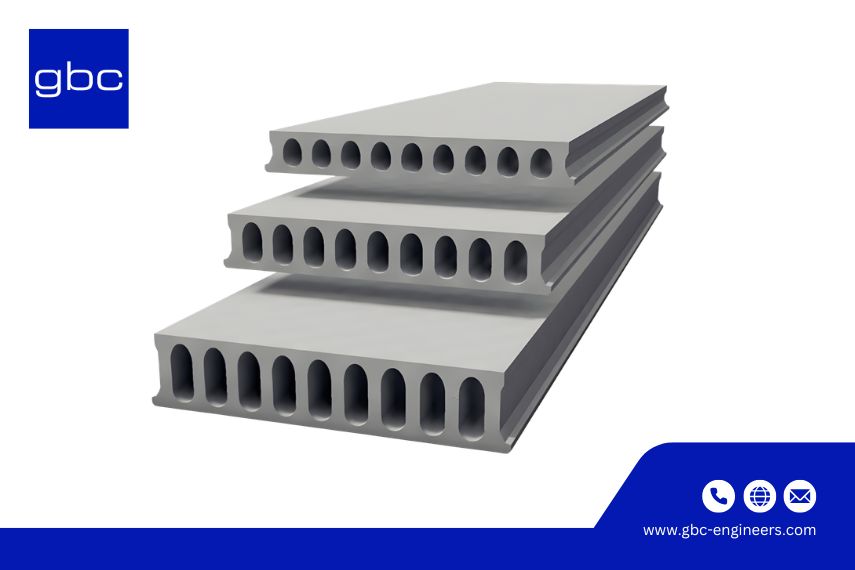
A precast hollow core slab (HCS) is a factory-produced, prestressed concrete floor or roof element containing continuous longitudinal voids. These voids reduce material consumption while maintaining structural performance through prestressing.
For data centers, precast hollow core slabs are attractive because they combine:
- Fast construction and no propping
- High load-bearing capacity with reduced weight
- Lower embodied CO₂
- Large spans for flexible IT hall layouts
- A flat soffit that improves airflow and supports cable tray routing
These advantages align well with the technical and commercial drivers of modern data center development.
Read more: Data Center Understanding live load requirements
Main Structural Benefits of Precast Prestressed Hollow Core Slabs
Material Efficiency and Weight Reduction
The geometry of an HCS concentrates material at the top and bottom—the zones contributing most to bending resistance. The voids, located near the neutral axis, remove concrete that contributes little to flexural strength.
As a result:
- 30–50% material savings are typical
- Bending capacity remains comparable to a solid RC slab of equal depth
- Overall slab weight is significantly reduced, lowering foundation and column loads
CO₂ Reduction
Because of optimized material usage and reduced transportation weight, HCS systems typically achieve:
- 20–40% lower embodied CO₂ compared to cast-in-place reinforced concrete slabs
This is increasingly important for datacenter developers targeting ESG or EU taxonomy compliance.
Cost Efficiency
Slabs are produced in 100–150 m long casting beds using highly automated extrusion or slip-forming processes.
Overall project savings of:
are documented when replacing conventional RC slabs.
Production and Installation Speed
HCS can be installed extremely quickly:
- Typical installation: 300–600 m²/day
- Optimized crews: 800–1200 m²/day
They are self-supporting, usually requiring no temporary propping, allowing MEP trades to start installation immediately below the slabs.
Fire Resistance
Most hollow core systems achieve REI 60–120 depending on depth and strand cover, typically without additional cladding or protection.
Read more: How Precast Allows Quick and Easy Construction for Data Centers
Main Structural Disadvantages of Precast Hollow Core Slabs
While Precast Hollow Core Slabs offer significant advantages in speed and efficiency, their application in Data Centers requires careful consideration of several structural limitations.
Reduced Shear Capacity Near Supports
The longitudinal voids reduce the available shear- and web-resisting area.
HCS have no transverse reinforcement, so shear resistance depends heavily on:
- Web geometry
- Concrete strength
- Support stiffness
At flexible supports (e.g., steel beams), increased rotation further reduces shear capacity and may limit allowable loads despite sufficient bending capacity.
Limited Penetration Size and Flexibility
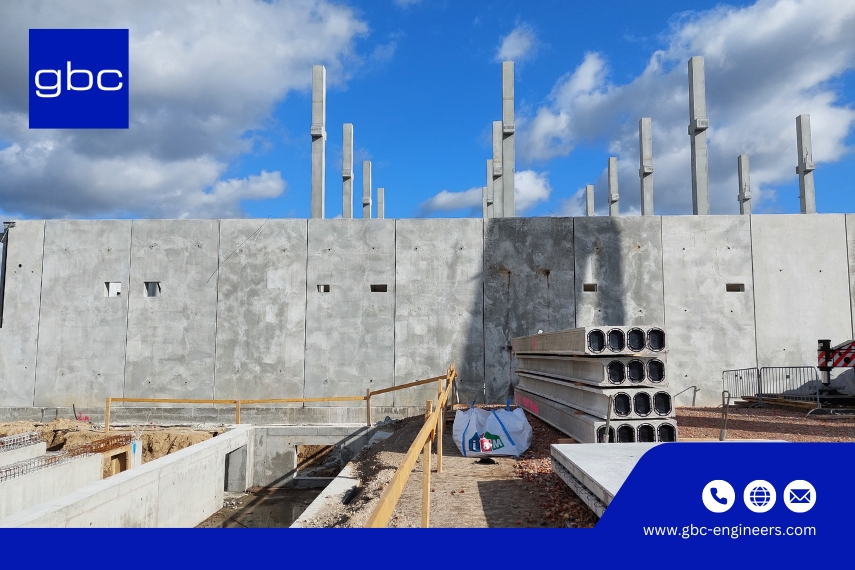
Each rib behaves as an individual beam. Cutting a rib or, worse, a prestressing strand, significantly reduces load capacity.
Implications:
- Only small, pre-planned penetrations between ribs are feasible
- Enlarging or relocating penetrations may invalidate slab design
- Large openings require special detailing or separate framing
- Data centers requiring high MEP flexibility must coordinate penetrations very early
Lateral Load Distribution Requires Careful Detailing
A hollow core floor is not a monolithic slab. For data center structures with significant wind or seismic demands:
- Shear keys and grout alone may not provide sufficient diaphragm action
- A topping concrete layer is often required to ensure safe load transfer to shear walls or frames
- In highly loaded regions, locally cast in-situ strips may be necessary
Limited Structural Continuity
HCS systems are typically simply supported. Achieving negative bending reinforcement at supports is difficult, restricting continuity and moment redistribution.
Opening Coordination and Future Adaptability
Because HCS rely on discrete ribs, they offer less flexibility for future upgrades—an important consideration for datacenters with evolving mechanical and electrical requirements.
Read more: AI Data Center Design: The Future of Data Center Technology
Conclusions and Recommendations
Conclusions
Precast prestressed hollow core slabs offer a compelling combination of speed, sustainability, load-bearing efficiency, and reduced structural weight, making them particularly attractive for datacenter applications where rapid deployment and high floor capacity are essential.
Their flat soffit, ability to achieve long spans, and strong vibration performance create clear architectural and operational advantages for IT halls.
However, the system also presents limitations that must be carefully managed.
Reduced shear capacity near supports, restricted flexibility for slab penetrations, and requirements for bonded diaphragm action can affect building adaptability and structural robustness.
These constraints necessitate early and precise coordination between architectural, structural, and MEP disciplines.
Recommendations
To maximize the benefits of Precast Prestressed Hollow Core Slabs while addressing their inherent limitations, the following recommendations should be considered when designing Data Centers:
- Use hollow core slabs where speed, large spans, and high live loads are priorities, especially in single- or multi-storey data centers.
- Engage structural and MEP engineers early to coordinate openings, rib layouts, and cable routes. Unplanned penetrations should be avoided.
- Ensure adequate diaphragm design, using topping concrete or in-situ strips in areas with high lateral load demand.
- Avoid placing major penetrations near supports, where shear capacity is lowest.
- Consider HCS primarily as simply supported elements. If continuity is desired, evaluate alternatives or hybrid systems.
- Review future adaptability requirements. If the data center is expected to undergo significant MEP changes, assess whether HCS penetration limitations align with long-term strategies.
- Perform vibration analysis—although HCS generally performs well, confirm compliance with data center criteria (VC curves).
With proper design, precast hollow core slabs can provide a highly efficient, fast-to-build, and sustainable flooring solution that aligns well with modern data center needs.
|
About us
gbc engineers is an international engineering consultancy with offices in Germany, Poland, and South East Asia, having delivered 500+ projects worldwide. We provide services in structural engineering, data center design, infrastructure and bridge engineering, BIM & Scan-to-BIM, and construction management. Combining German engineering quality with international expertise, we achieve sustainable, safe, and efficient solutions for our clients.
|