Reviewed by Yoan Guyon, Managing Director at gbc engineers
AI and HPC servers have pushed rack power from 5 to 15 kW to 50 kW, 100 kW or more. At those densities, traditional air cooling runs out of headroom.
In this article, gbc engineers compares Direct-to-Chip (DTC) cooling and immersion cooling from an engineering and operational perspective. The goal is to help data center owners, operators and design teams understand how each system works, where each option performs best and what should be checked before making an investment decision.
What is the difference between direct to chip and immersion cooling?
Direct to chip vs immersion is not a simple question of which technology is better. Direct to chip cooling removes heat from processors and accelerators through cold plates while the rest of the server still uses airflow. Immersion cooling places the server board inside dielectric fluid, allowing the cooling medium to absorb heat from more components at once.
For most data centers, the right choice depends on rack density, server compatibility, retrofit constraints, maintenance skills, energy targets and the long-term IT roadmap. Direct to chip cooling is usually easier to introduce into existing environments, while immersion cooling becomes more attractive when very high-density AI or HPC workloads are planned from the beginning.
How direct to chip cooling works
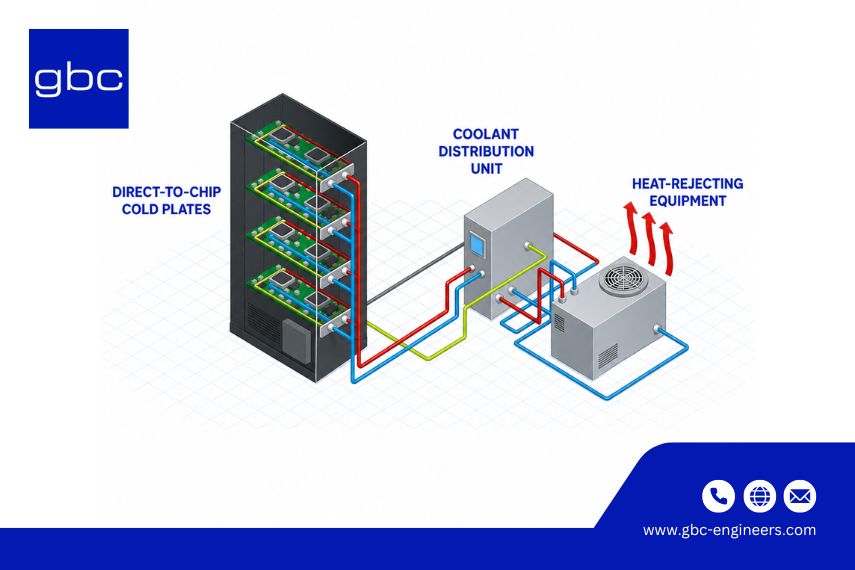
Direct to chip cooling places a cold plate directly onto the server CPU, GPU or accelerator package. A water glycol coolant or another engineered coolant flows through microchannels inside the cold plate, absorbs heat at the source and carries it to a coolant distribution unit, also called a CDU, or to the facility cooling loop.
Cold plate technology and CDU integration
Cold plate technology is the core of direct to chip cooling. The plate must sit tightly against the chip package, transfer heat efficiently and maintain reliable contact pressure through repeated thermal cycles. For AI data center cooling, the cold plate design must also match the heat profile of modern GPUs, where heat flux can be concentrated in a small area.
The CDU controls coolant temperature, pressure and flow rate, and isolates the server loop from the building water loop to protect IT hardware from pressure variation and maintenance events.
Key DTC system components
- Cold plates mounted directly on CPU, GPU or accelerator packages
- Coolant distribution units for flow, pressure and temperature control
- Quick disconnect fittings that allow server maintenance with minimal coolant exposure
- Rack manifolds that distribute coolant to multiple servers
- Facility integration with chilled water, warm water loops, dry coolers or rear door heat exchangers
How immersion cooling works in data centers
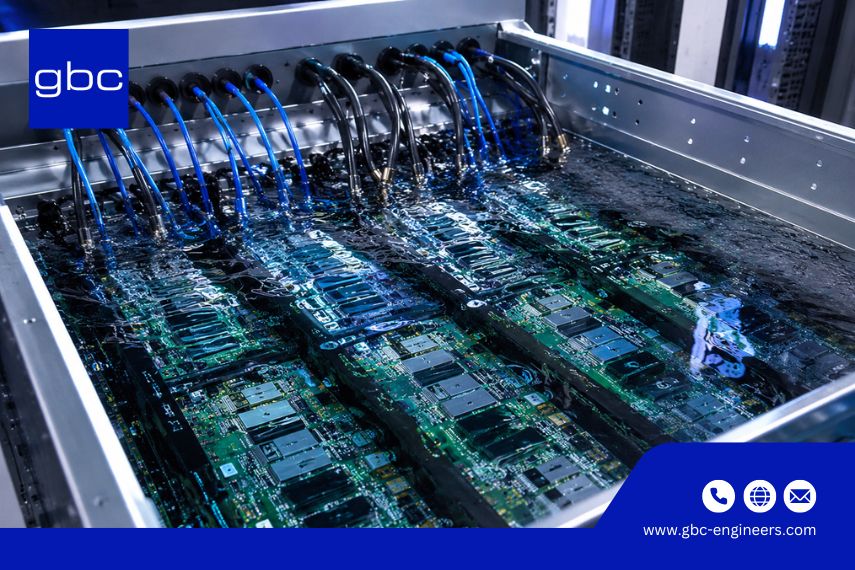
Immersion cooling takes a different approach. Instead of moving liquid only to the hottest chips, the server board is submerged in a dielectric fluid that is electrically non-conductive and thermally efficient. The fluid absorbs heat directly from processors, memory, power electronics and other components at the same time.
This broader heat removal coverage is why immersion cooling can support extremely high-density rack and tank configurations. However, it also changes the operating model. Server handling, warranty review, fluid monitoring, tank layout, floor loading and containment all become part of the design decision.
There are two main types of immersion cooling systems, and understanding the distinction matters when evaluating which suits your operational environment:
Single phase immersion
In single phase immersion systems, the dielectric fluid remains liquid throughout operation. The warm fluid is circulated through a heat exchanger, cooled and returned to the tank. This is the more mature and easier to manage form of immersion cooling because the system behavior is predictable and the fluid does not boil during normal operation.
Single phase immersion is often considered for high-density GPU clusters, research environments, edge deployments and facilities that want strong energy efficiency without moving directly to the complexity of two phase systems.
Two phase immersion
Two phase immersion uses a dielectric fluid with a low boiling point. The fluid vaporizes when it contacts hot components, the vapor rises to a condenser and then returns to the tank as liquid. The phase change process can deliver very high heat transfer rates, which makes it suitable for extreme density workloads.
The tradeoff is complexity. Two phase systems require sealed operation, careful fluid selection, strict containment and specialist maintenance procedures. Because some legacy fluids are being replaced due to environmental and supply considerations, project teams should review fluid availability, global warming potential and long-term supplier support before specifying a system.
Dielectric fluid selection and management apply to both immersion types, though the requirements are stricter for two phase. Fluids must be non-conductive, chemically stable and compatible with electronic materials over long thermal cycling. Operators also need procedures for contamination control, fluid sampling, top-up and end-of-life handling — these requirements carry real OPEX and training implications that should be factored into the project assessment.
Read more: Data Center Cooling: How Modern Systems Improve Efficiency and Sustainability
Direct-to-Chip vs immersion cooling: side by side comparison
|
Criteria
|
Direct-to-Chip (DTC)
|
Immersion cooling
|
|
Cooling method
|
Cold plate on CPU or GPU, airflow for remaining components
|
Server board submerged in dielectric fluid
|
|
Heat removal coverage
|
Primary heat generating components
|
Most or all immersed components
|
|
Typical rack density range
|
30 to 100 kW per rack
|
50 to 250+ kW per rack depending on system type
|
|
Cold plate cooling required
|
Yes
|
No
|
|
Dielectric fluid required
|
No for standard DTC loops
|
Yes
|
|
Standard rack compatibility
|
Generally compatible with standard racks
|
Requires tanks or immersion ready enclosures
|
|
Retrofit suitability
|
Strong for phased upgrades
|
Complex and usually better for greenfield or major upgrades
|
|
OEM server compatibility
|
Good where cold plate options are available
|
Requires immersion ready hardware and warranty review
|
|
Upfront CAPEX
|
Moderate
|
High
|
|
OPEX profile
|
Moderate, familiar maintenance model
|
Potentially lower energy OPEX at scale, higher fluid handling requirements
|
|
PUE potential
|
Typically around 1.03 to 1.15
|
Typically around 1.02 to 1.05
|
|
Best suited for
|
Retrofits, mixed density rooms, standard OEM platforms
|
Greenfield AI or HPC campuses, ultra high-density deployments
|
Rack density and AI/HPC workloads
Rack density is usually the first decision trigger. Many existing enterprise data centers were designed around air-cooled racks in the 5 to 15 kW range. AI and HPC workloads change that baseline because GPU servers concentrate more power and heat into fewer rack units.
For a high-density rack cooling strategy, average room density is less useful than peak rack density. A facility may look manageable at an average of 10 kW per rack, while several AI racks inside the same room require 80 kW or more. Those peak loads determine whether direct to chip cooling, immersion cooling or a hybrid approach is needed.
Density guidance by cooling approach
- Direct to chip cooling is usually well suited for 30 to 100 kW per rack when OEM support and facility water integration are available
- Single phase immersion can be effective from roughly 50 to 150 kW per rack or equivalent tank density
- Two phase immersion is most relevant when densities consistently exceed 100 kW and the operator can manage sealed system complexity
- Hybrid air and liquid environments are practical when only part of the IT load is high density
Energy efficiency, PUE and sustainability impacts
PUE, or Power Usage Effectiveness, is the most common efficiency metric for data centers. Liquid cooling can reduce fan energy and compressor dependency, which is why DTC and immersion cooling often achieve lower PUE values than conventional air-cooled facilities. The exact improvement depends on climate, water temperature, heat rejection method, controls strategy and operating load. Both approaches can also support sustainability goals beyond PUE: DTC enables warmer water operation and waste heat reuse, while immersion can reduce or eliminate evaporative water consumption.
CAPEX, OPEX and total cost of ownership
The cost comparison between direct to chip cooling and immersion cooling is not only about the first purchase price. The better question is how CAPEX, OPEX, deployment risk and lifecycle value combine over the expected operating period.
Direct to chip cooling cost profile
- Lower upfront infrastructure cost than full immersion in most retrofit projects
- Good compatibility with standard OEM servers where cold plate configurations are offered
- CDUs, manifolds, pipework and monitoring are the main capital items
- Maintenance is closer to familiar server and mechanical workflows
- Best total cost position for smaller scale, phased deployment and mixed density facilities
Immersion cooling cost profile
- Higher initial CAPEX for tanks, dielectric fluid inventory, containment and modified IT handling
- Potentially lower energy OPEX at large scale because less air movement and less mechanical cooling may be required
- Additional OPEX for fluid testing, fluid top-up, staff training and specialized maintenance procedures
- Best total cost position where high-density workloads are stable, large scale and planned from the beginning
As a general rule, DTC tends to offer a lower total cost of ownership at smaller scale and in retrofit scenarios. Immersion cooling delivers stronger long-term economics in large-scale greenfield deployments where its energy efficiency gains compound over years of operation.
Retrofitting, scalability and reliability
Choosing the right cooling system is only half the decision: the building has to be able to support it.
Retrofitting existing data centers
Direct to chip cooling is generally the more practical retrofit option. It can be introduced rack by rack, often within standard enclosures, and it allows operators to keep air cooling for lower density areas. The design still needs a careful review of CDU placement, pipe routes, raised floor or overhead distribution, maintenance access and structural loads.
Immersion cooling is more difficult to retrofit. Tanks can be heavy, require new working clearances and often need revised electrical and fire protection strategies. For this reason, immersion is usually strongest in greenfield facilities, dedicated AI rooms, containerized modules or major refurbishments where the building and operating model can be planned around the technology.
Scalability considerations
DTC scales well when the operator wants to densify gradually. Additional liquid cooled racks can be added as workloads grow, provided the CDU capacity, pipework and heat rejection system have been planned with expansion in mind.
Immersion scales differently. It can deliver excellent density per square meter, but the scaling unit is often the tank, module or pod rather than the individual rack. This can be efficient for large AI or HPC deployments, but it requires stronger coordination between IT procurement, facility design and operations planning.
Maintenance complexity and reliability
DTC systems bring liquid closer to electronics, so leak detection, connection quality and maintenance discipline are essential. However, quick disconnect fittings and familiar rack-based workflows make the operating change manageable for many data center teams.
Immersion cooling removes most server fans, which can reduce mechanical failure points. At the same time, it introduces new reliability considerations: fluid cleanliness, material compatibility, tank access, component drying procedures and warranty conditions.
Read more: Air vs Liquid Cooling in Data Centers: When Should You Make the Switch?
Decision framework: Choosing the right solution
The guidance below reflects common data center planning situations rather than one universal answer.
When direct to chip cooling is most suitable
- Existing data centers adding AI or HPC capacity without a full facility rebuild
- Mixed density rooms where only selected racks exceed air cooling limits
- Facilities that need standard OEM server compatibility and familiar maintenance workflows
- Projects where speed of deployment and phased investment are priorities
- Operators targeting strong efficiency gains without changing the entire IT handling model
When immersion cooling is most suitable
- Greenfield AI or HPC facilities designed around ultra high-density from day one
- Dedicated GPU training clusters with sustained high utilization
- Sites where space efficiency and low fan energy are major priorities
- Operators with the skills, procedures and supplier support to manage dielectric fluids
- Projects where long-term energy efficiency can justify higher initial CAPEX
When a hybrid strategy makes sense
A hybrid strategy is often the most realistic path. Standard compute can remain air-cooled, medium to high-density racks can move to direct to chip cooling and the most demanding AI or HPC clusters can be planned for immersion where justified. This approach reduces risk because the facility gains liquid cooling capability progressively instead of committing all workloads to one technology at once.
Conclusion
Direct-to-Chip and immersion cooling are both important answers to the same problem: modern data centers need to remove far more heat from far smaller footprints. DTC is usually the practical and scalable choice for retrofit projects, mixed density rooms and OEM compatible AI deployments. Immersion cooling is more compelling where ultra high-density, low fan energy and long-term energy efficiency are the project's priorities.
The best decision comes from a project-specific assessment of rack density, facility constraints, cooling water strategy, structural capacity, maintenance capability and lifecycle cost. gbc engineers supports data center owners and project teams by reviewing these interfaces early, before cooling choices become expensive construction or operational problems.
Frequently asked questions
Is direct to chip cooling enough for AI workloads?
Yes, in many cases. Direct to chip cooling can support many AI and HPC deployments when rack densities sit in the 30 to 100 kW range and suitable cold plate servers are available. For densities consistently above 100 kW, immersion cooling or a dedicated liquid cooling architecture may provide better long-term headroom.
What is the main operational difference between single phase and two phase immersion?
Single phase immersion keeps the dielectric fluid in liquid form and is generally easier to manage. Two phase immersion uses boiling and condensation, which can increase heat transfer but also requires stricter containment, fluid selection and maintenance control.
Can immersion cooling be retrofitted into an existing data center?
It can be retrofitted, but it is usually a major upgrade rather than a simple rack replacement. The project team must check floor loading, tank access, electrical layout, containment, fire strategy, fluid handling procedures and server warranty conditions. Direct to chip cooling is usually easier to retrofit incrementally.
Which option is more sustainable?
Both can improve sustainability compared with conventional air cooling. DTC can reduce fan energy and enable warmer water operation. Immersion cooling can reduce fan energy further and may reduce water consumption when paired with closed loop heat rejection. The better option depends on the local climate, energy mix, water constraints, fluid lifecycle and opportunities for heat reuse.
What should be checked before choosing a liquid cooling system?
Key checks include current and future rack density, AI and HPC workload roadmap, OEM server compatibility, CDU or tank space, structural floor loading, facility water temperatures, redundancy requirements, maintenance skills, leak detection, CAPEX, OPEX and sustainability targets.
Does liquid cooling remove the need for air cooling completely?
Not always. Direct to chip cooling still requires airflow for parts of the server and for room level heat loads. Immersion cooling can remove most server fan requirements, but the facility may still need air management for power equipment, network areas, service spaces and staff comfort.
|
About us
gbc engineers
is an international engineering consultancy with offices in Germany, Poland, and South East Asia, having delivered 500+ projects worldwide. We provide services in structural engineering, data center design, infrastructure and bridge engineering, BIM & Scan-to-BIM, and construction management. Combining German engineering quality with international expertise, we achieve sustainable, safe, and efficient solutions for our clients.
|