Earthquake-resistant building design is a core requirement for resilient buildings in seismic regions. It is not only about preventing collapse during a major earthquake, but also about controlling damage, protecting occupants, and helping critical facilities return to operation faster after seismic events.
In this article, gbc engineers outlines 3 key criteria for earthquake-resistant building design: planning and layout, structural system design, and the analysis and detailing of critical sections. The article also references current standards such as Eurocode 8, ASCE 7, and regional codes used across Europe and Southeast Asia.
What is earthquake-resistant building design?
Earthquake-resistant (seismic-resistant) building design is the application of structural engineering principles, material science, and code-based analysis methods to ensure that buildings can safely withstand ground motion caused by earthquakes. The primary objective is life safety - preventing collapse - while performance-based approaches also target minimization of structural damage and post-earthquake functional continuity.
How earthquakes affect buildings
When an earthquake occurs, seismic waves cause ground motion that exerts dynamic, time-varying forces on structures. Unlike static gravity loads, seismic forces act in multiple directions simultaneously - primarily horizontally - and can reverse direction many times per second, subjecting structural elements to rapid cyclic loading.
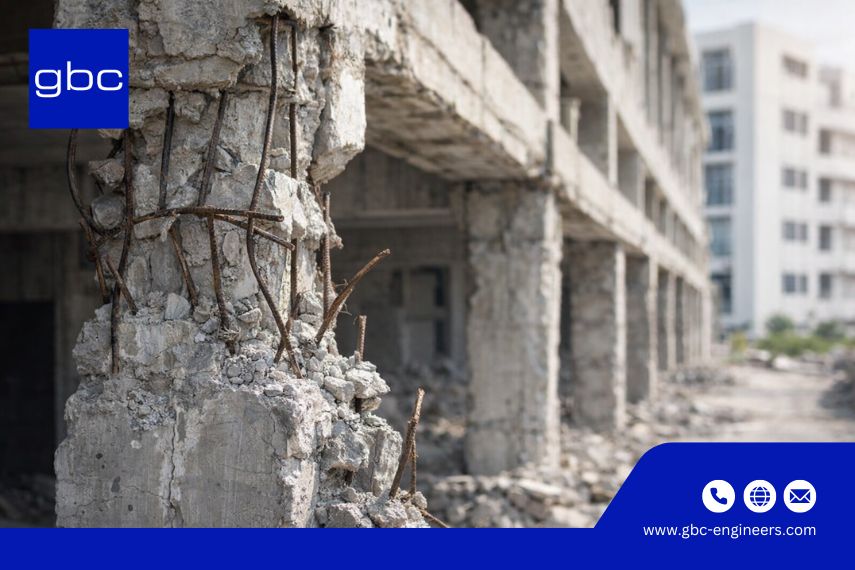
Common earthquake damage mechanisms include:
- Shear failure of columns and walls lacking adequate transverse reinforcement
- Soft-story collapse - concentration of damage in a floor with significantly lower lateral stiffness than adjacent floors
- Foundation failure due to soil liquefaction in saturated, loose granular soils
- Pounding damage between adjacent buildings with incompatible floor heights
- Non-structural damage: cladding, partitions, MEP systems, raised floors, which is critical in data centers
Performance hierarchy in modern seismic design
The fundamental objective of earthquake-resistant design is not to prevent all damage in the largest conceivable earthquake, but to ensure the following performance hierarchy, codified in modern seismic standards:
|
Performance level
|
Design earthquake return period
|
Objective
|
|
Serviceability (damage limitation)
|
~95-year return period (10% in 10 years)
|
Minor damage; no structural repair required; immediate re-occupancy
|
|
Life safety (no collapse)
|
~475-year return period (10% in 50 years)
|
Significant damage possible; no collapse; life safety preserved
|
|
Collapse prevention (near collapse)
|
~2475-year return period (2% in 50 years)
|
Severe damage; structure near collapse but does not fail
|
Seismic design standards: a global reference guide
The appropriate seismic design standard depends on the project location. gbc engineers works with the following primary standards across our European and Southeast Asian markets:
|
Region / country
|
Primary seismic standard
|
Key feature
|
Status
|
|
European Union
|
Eurocode 8 (EN 1998-1:2004)
|
Performance-based; National Annexes define PGA maps
|
1st generation remains the normal design basis today; 2nd generation Eurocodes have a DoP of 30 Sep 2027 and DoW of 30 Mar 2028
|
|
USA
|
ASCE 7-22
|
Risk-targeted ground motions; Seismic Design Categories A–F
|
Current edition; referenced by IBC 2024
|
|
China
|
GB 50011-2010 (2016 rev.)
|
3-level performance objective (small, medium, large earthquakes)
|
Current; revision under discussion
|
|
Indonesia
|
SNI 1726:2019
|
Based on probabilistic hazard maps; 4 site classes
|
Current
|
|
Vietnam
|
TCVN 9386:2012
|
Adapted from Eurocode 8; Vietnamese National Annex
|
Current
|
|
Thailand
|
EIT Standard 1012-46
|
Based on UBC 97; update in progress toward Eurocode 8 alignment
|
Under revision
|
|
Singapore
|
SS EN 1998 (2021)
|
Singapore Standard adopting Eurocode 8; low seismic hazard but design still required
|
Current
|
|
India
|
IS 1893:2016 (Parts 1-5)
|
Zone II–V classification; response spectrum approach
|
Current
|
|
Japan
|
BSL (2000, amended 2024)
|
2-level design; strong emphasis on base isolation and supplemental damping
|
Current; national provisions continue to evolve through MLIT notices and code updates
|
.jpg)
Read more: Earthquake-Resistant Design Concepts: How It Helps Protect Buildings in Southeast Asia
What are the 3 key criteria for earthquake-resistant building design?
Effective seismic design integrates three interdependent criteria. Deficiency in any single criterion can undermine the overall seismic performance of a structure, regardless of how well the other two are addressed.
Criterion 1: planning and layout
Architectural and structural planning decisions made in the earliest design stages have the greatest influence on seismic performance and the lowest remediation cost if problems are identified early.
- Structural regularity in plan and elevation: Irregular buildings such as L-shapes, setbacks, re-entrant corners, or buildings with mass or stiffness irregularities experience amplified torsional responses and concentrated damage during earthquakes. Both Eurocode 8 (EN 1998-1 cl. 4.2) and ASCE 7-22 (Section 12.3) define specific regularity criteria that determine whether simplified analysis methods can be used.
- Minimizing torsional eccentricity: The horizontal distance between the center of mass (CM) and center of stiffness (CR) of each floor creates torsional response. Eurocode 8 requires the eccentricity ratio to be limited, typically e/L ≤ 0.30, to qualify for simplified analysis methods.
- Lateral force-resisting element distribution: Shear walls, braced frames, or moment frames should be arranged symmetrically in plan and as close to the building perimeter as practicable to maximize torsional stiffness.
- Avoiding short columns and captive columns: Partial-height infill walls that restrain columns over part of their height create short column or captive column conditions, among the most common causes of column shear failure in past earthquakes.
- Site selection and geotechnical assessment: Eurocode 8 defines 5 ground types (A to E) and 2 special ground types (S1: liquefiable/sensitive; S2: deep deposits with special characteristics). Site-specific response spectra are required for S1 and S2 ground types. In Southeast Asia, the prevalence of soft alluvial soils (Eurocode 8 Ground Type D/E) in coastal cities such as Jakarta, Bangkok, and Ho Chi Minh City significantly amplifies seismic ground motion and must be addressed in foundation design.
.jpg)
Criterion 2: structural system design
The structural system must provide a continuous, ductile, and redundant load path for seismic forces from every point in the building to the foundation.
Capacity design philosophy: The structure is designed so that inelastic energy dissipation occurs in pre-selected ductile elements, such as plastic hinges in beams, while brittle elements such as columns and connections are protected by deliberate overstrength. This is the core philosophy of Eurocode 8 Ductility Class Medium (DCM) and High (DCH), and ASCE 7-22 Special and Intermediate seismic force-resisting systems.
Lateral force-resisting systems
Common seismic-resistant structural systems and their typical application heights include:
|
Structural system
|
Typical application
|
Standard reference
|
|
RC ductile coupled walls
|
Mid-to-high-rise (up to 200 m)
|
EC8 cl. 5.4/5.5; ACI 318-19 Ch. 18
|
|
Steel special moment frames (SMF)
|
High-rise in high seismic zones
|
AISC 341-22; ASCE 7-22
|
|
RC special moment frames
|
Mid-rise; combined with walls
|
ACI 318-19; EC8 cl. 5.4/5.5
|
|
Eccentrically braced steel frames
|
Industrial; medium-high seismic
|
AISC 341-22
|
|
Dual systems (wall + frame)
|
Provides redundancy; preferred for essential facilities
|
EC8 cl. 5.2.2; ASCE 7-22
|
|
Base isolation (LRB, FPS)
|
Essential facilities, museums, data centers
|
EN 15129; ASCE 7-22 Ch. 17
|
- Avoiding soft stories: A soft story, meaning a floor significantly less stiff than adjacent floors, or a weak story, meaning a floor significantly weaker, concentrates inelastic deformation and is a primary cause of partial or complete building collapse in earthquakes. ASCE 7-22 and Eurocode 8 both define quantitative irregularity thresholds that trigger mandatory analysis requirements.
- Foundation design for seismic loading: Foundations must transfer seismic overturning moments and base shear to competent bearing strata. Tie beams connecting isolated footings, piled raft foundations, and ground improvement techniques such as vibro-compaction and deep mixing are commonly used in Southeast Asian soft soil conditions.
Read more: Top 5 Benefits of Earthquake-Resistant Designs for Modern Buildings
.jpg)
Criterion 3: analysis and detailing of critical sections
The structural detailing of critical sections - particularly connections and plastic hinge zones - determines whether the designed ductility capacity is actually achieved in a real earthquake.
- Beam-column joint detailing: Joints in RC moment frames are among the most stressed elements under seismic loading. Eurocode 8 Section 5.4.3.3 (DCM) and 5.5.3.3 (DCH) define minimum joint shear reinforcement and stirrup requirements. ACI 318-19 Chapter 18 provides equivalent requirements for North American practice.
- Confinement in columns and wall boundary elements: Closely spaced hoops and cross-ties within the critical regions, such as plastic hinge zones at column bases and wall base sections, are essential for ductile behavior. Eurocode 8 DCH requires minimum confinement reinforcement ratios (mechanical volumetric ratio αωwd ≥0.08).
- Lap splice locations: Lap splices in columns must not be located within critical regions, typically within 1.5× the section depth from the joint face. Eurocode 8 cl. 5.4.3.2.2 prohibits lap splices in critical regions of primary seismic columns. ASCE 7-22 / ACI 318-19 impose equivalent restrictions.
- Material specifications: Reinforcing steel must meet ductility Class C (high ductility) per EN 1992-1-1 / EN 10080 for EC8 DCH structures. In North America, ASTM A706 Grade 60, a low-alloy reinforcing steel with controlled carbon equivalent, is specified for seismic applications. Concrete compressive strength should be ≥20 MPa for DCM and ≥25 MPa for DCH per Eurocode 8.
- Seismic isolation and supplemental damping for data centers: Data centers and other mission-critical facilities are prime candidates for seismic base isolation due to the high cost of post-earthquake downtime and the sensitivity of IT equipment to floor accelerations. Base isolation reduces peak floor accelerations by 3–5×, protecting both the structure and its contents. EN 15129 (Anti-seismic devices) governs the design, testing, and quality assurance of seismic isolation and energy dissipation devices in Europe.
- Non-structural element seismic protection: Non-structural damage accounts for 50–80% of total economic losses in moderate earthquakes (FEMA P-58). In data centers, the seismic anchorage of server racks, UPS systems, raised floor pedestals, cooling units, and overhead cable trays must be designed as part of the overall seismic strategy. ASCE 7-22 Chapter 13 and Eurocode 8 cl. 4.3.5 provide the framework for non-structural seismic design.
Ready to Build Your Next-Generation Building?
Partner with gbc engineers to design a facility that delivers performance, reliability, and long-term value.
🌐 Visit: www.gbc-engineers.com
🏗️ Explore Our Services: Services - gbc engineers
Conclusion
The three key criteria for earthquake-resistant building design are interdependent and must be addressed holistically throughout the entire design process, from site selection to construction detailing.
Compliance with applicable seismic design standards such as Eurocode 8, ASCE 7, SNI 1726, or national equivalents is the minimum baseline. For European projects, that usually still means the first-generation EN 1998 parts today, with the second-generation Eurocodes rolling in on the 2027/2028 timetable rather than 2025-2026.
At gbc engineers, we integrate seismic design expertise across our structural engineering services for data center and industrial facility projects in Europe and Southeast Asia. Our team applies rigorous hazard analysis, system optimization, and code-compliant detailing to deliver structures that protect lives, assets, and critical operations.
Frequently asked questions
1. What is the difference between Eurocode 8 and ASCE 7 for seismic design?
Both are performance-based seismic design standards, but they use different frameworks. Eurocode 8 (EN 1998-1) uses Peak Ground Acceleration (PGA) from national hazard maps and defines Ductility Classes (DCL, DCM, DCH) for structural systems. ASCE 7-22 uses Risk-Targeted Maximum Considered Earthquake (MCER) spectral accelerations and defines Seismic Design Categories (SDC A–F).
In Europe today, the first-generation Eurocode 8 remains the normal basis in force while the second-generation package transitions toward publication in 2027 and withdrawal of conflicting standards in 2028.
2. What seismic design standard applies in Southeast Asia?
It varies by country: Indonesia uses SNI 1726:2019; Vietnam uses TCVN 9386:2012, based on Eurocode 8; Singapore uses SS EN 1998 (2021, adopting Eurocode 8); Thailand’s EIT standard is currently being revised toward Eurocode 8 alignment; Malaysia references Eurocode 8 (MS EN 1998). For projects spanning multiple SEA countries, familiarity with both Eurocode 8 and local national annexes is essential.
3. Do data centers need special seismic design considerations?
Yes. Data centers are classified as essential or critical facilities under most seismic design codes, requiring enhanced performance objectives, such as Importance Class III or IV in Eurocode 8 and Risk Category III/IV in ASCE 7.
Additionally, the seismic anchorage of non-structural components - server racks, UPS systems, raised floor pedestals, cooling units - must be explicitly designed. For high-value or always-on facilities, seismic base isolation is increasingly specified to protect both structure and IT equipment from floor accelerations.
|
About us
gbc engineers
is an international engineering consultancy with offices in Germany, Poland, and South East Asia, having delivered 500+ projects worldwide. We provide services in structural engineering, data center design, infrastructure and bridge engineering, BIM & Scan-to-BIM, and construction management. Combining German engineering quality with international expertise, we achieve sustainable, safe, and efficient solutions for our clients.
|