A well-structured data center layout is the foundation of stable, continuous IT infrastructure operation. Whether you are in the early-stage design phase or managing an existing operational facility, two questions define every data center:
- What are the core components of a data center?
- What physical infrastructure does a data center facility require?
In this guide, gbc engineers explains how a typical data center layout is organized, what each zone contributes to overall performance and reliability, and what 2026 design priorities are reshaping facilities worldwide.
What is a data center layout?
A data center layout is the planned physical organization of IT infrastructure, power systems, cooling equipment, and security controls within a data center facility. A well-designed layout ensures 24/7 operational reliability, energy efficiency, physical security, and scalability for future growth.
The three key zones of a data center layout
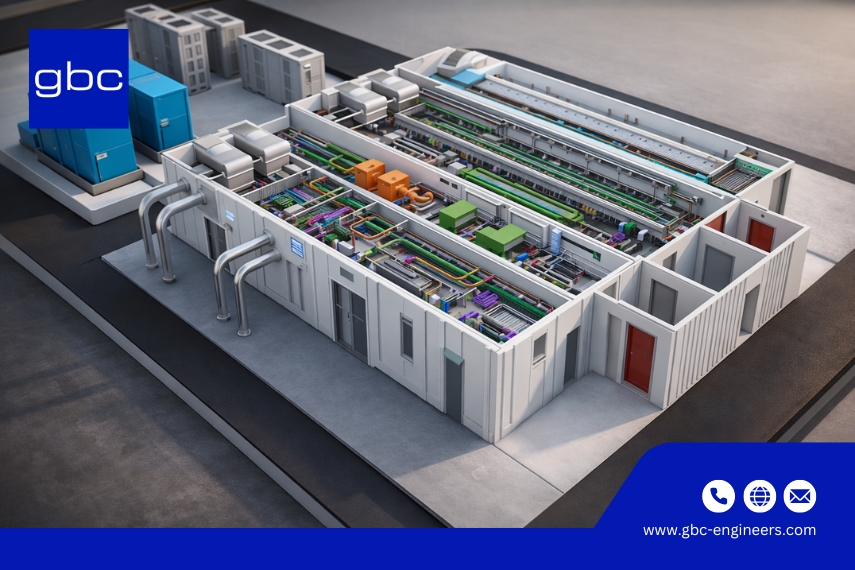
A standard data center layout is organized into three primary functional zones, each serving a distinct and critical role:
|
|
|
|
|
|
IT processing, storage, networking
|
Servers, switches, routers, firewalls, storage arrays
|
|
|
Power supply, conditioning, backup
|
UPS, generators, PDUs, switchgear, transformers
|
Network Operations Center (NOC)
|
24/7 monitoring, management, incident response
|
Video walls, DCIM, alert systems, remote access controls
|
1. Server Room (Computer Room)
The Server Room is the operational heart of the data center, housing all critical IT equipment. It is a climate-controlled, access-restricted space designed to maximize compute density while maintaining optimal operating conditions.
Standard Server Room equipment includes:
- Servers: Rack-mount, blade, or modular compute nodes for processing and local storage
- Top-of-Rack (ToR) Switches & Core Routers: Providing internal east-west and external north-south network connectivity
- Firewalls & Load Balancers: For perimeter security, traffic management, and application delivery
- Storage Systems: SANs, NAS arrays, and all-flash NVMe storage for high-performance data management
- Application Delivery Controllers (ADCs): Optimizing application performance and availability
Modern server rooms increasingly operate at high densities (10–30+ kW/rack for standard workloads; 40–100+ kW/rack for AI/GPU clusters), driving the adoption of direct liquid cooling (DLC) and immersion cooling at the rack level alongside traditional air-based cooling.
ASHRAE TC 9.9 defines recommended operating envelopes for IT equipment. Class A2 equipment — the most common classification for enterprise servers — is rated for inlet air temperatures of 10–35°C (50–95°F), with an allowable range of 5–40°C (41–104°F). Most facilities target a supply air temperature of 18–27°C (64–80°F) to maintain safe operating margins.
2. Power Room
The Power Room manages all aspects of power delivery to the data center — from the utility connection to the individual rack. Its design directly determines the facility’s reliability, efficiency, and Tier classification.
Core Power Room components:
- Uninterruptible Power Supply (UPS): Provides seamless bridging power during utility interruptions while generators start. Double-conversion (online) topology per IEC 62040-3 Class VFI is standard for Tier III and Tier IV facilities.
- Backup Generators: Diesel or gas generators sized to carry the full facility load, typically with 12–48 hours of on-site fuel storage. Automatic transfer switches (ATS) ensure changeover within 10–30 seconds.
- Medium-Voltage Switchgear & Transformers: For facilities above ~1 MW, MV switchgear (10–22 kV in Europe; 12–25 kV in North America) steps down utility power via dry-type transformers.
- Power Distribution Units (PDUs): Floor-level distribution assemblies that step down and distribute power to IT racks, with branch circuit monitoring.
- Rack PDUs (rPDUs): Mounted within IT racks for final power delivery, with metering and (in managed variants) remote switching capability.
Modern facilities adopt A+B dual power feed architecture, supplying every critical IT load from two fully independent power paths. This eliminates any single point of failure in the power distribution chain.
Power Usage Effectiveness (PUE) — the ratio of total facility power to IT equipment power — is the primary energy efficiency metric. Targets by facility type:
|
|
|
|
Hyperscale (Google, Meta)
|
|
Google Environmental Report 2024; Meta Sustainability Report 2024
|
|
|
|
Uptime Institute Global DC Survey 2024
|
EU Code of Conduct compliant
|
≤1.3 (new) / ≤1.5 (existing)
|
EU DC Code of Conduct v14 (2024)
|
|
|
|
Uptime Institute Global DC Survey 2024
|
3. Network Operations Center (NOC)
The Network Operations Center is the central command hub for monitoring and managing the data center’s entire IT and physical infrastructure. In modern facilities, the NOC integrates IT monitoring, physical security, environmental controls, and energy management into a unified operational picture.
NOC capabilities typically include:
- Video wall displays showing real-time network topology, server health, and environmental dashboards
- Data Center Infrastructure Management (DCIM) software — the single pane of glass for capacity planning, asset management, and energy optimization
- Security Information and Event Management (SIEM) integration for cybersecurity monitoring
- Physical security systems: CCTV, access control (biometric + card reader), man-trap management
- Tier I–IV compliant incident response and change management procedures
DCIM platforms (for example Schneider Electric EcoStruxure IT, Vertiv platforms, and other enterprise monitoring tools) provide granular visibility into power, cooling, and compute capacity. They strongly support operational excellence and EU Article 12 data-center reporting, but the regulation does not mandate one specific DCIM product or platform.
 Read more: Top 10 Data Center Design Certifications to Elevate Your Career in 2025
Core Components of a Data Center: Technical Deep Dive
Computing Resources
Servers remain the primary computing asset. In 2025, data center server deployments span three architectural categories:
- General-purpose rack servers: 1U–2U rack-mount systems for web, application, and database workloads (e.g., Dell PowerEdge, HPE ProLiant, Lenovo ThinkSystem)
- GPU-accelerated compute nodes: High-density nodes equipped with NVIDIA H100/H200 or AMD MI300X GPUs for AI training and inference. Rack densities of 40–100 kW require liquid cooling.
- Hyperconverged infrastructure (HCI): Converged compute, storage, and networking in modular nodes (e.g., Nutanix, VMware vSAN) for software-defined data center deployments.
Storage Systems
Storage technologies used in data centers:
|
|
|
|
|
|
|
Databases, AI/ML, latency-sensitive applications
|
Storage Area Network (SAN)
|
FC or iSCSI block storage
|
Enterprise databases, virtualization
|
Network Attached Storage (NAS)
|
|
Media, backup, collaboration
|
|
|
S3-compatible (on-prem/cloud)
|
Big data, backups, unstructured data
|
Cooling Systems
Cooling is typically the second-largest energy consumer in a data center after IT equipment. The right cooling strategy depends on rack density and PUE targets:
|
|
|
|
|
CRAC/CRAH + Hot/Cold Aisle
|
|
|
Legacy / standard density
|
|
|
|
|
Medium density enterprise
|
Rear-door heat exchangers
|
|
|
|
Direct Liquid Cooling (DLC)
|
|
|
|
|
|
|
|
|
Free cooling (economizer mode) — using outside air or cooling tower water when ambient temperatures permit — is now standard in new European data center designs. In northern European climates (Sweden, Finland, Netherlands), free cooling is available for 80–95% of annual operating hours, dramatically reducing mechanical cooling energy. The EU Data Centre Code of Conduct strongly encourages free cooling adoption.
Fire Suppression Systems
Fire suppression in data centers uses clean-agent gaseous systems that suppress fires without water damage to sensitive electronics:
|
|
|
|
|
|
|
|
|
Restricted; phase-out under EU Reg. 2024/573
|
FK-5-1-12 clean-agent fluid*
|
|
|
Permitted; specify chemistry, product availability, and local approvals case by case
|
|
|
|
|
Permitted; inert gas blend
|
|
|
|
|
Permitted for specific applications
|
Note for European facilities: FM-200 (HFC-227ea) has a Global Warming Potential of 3,220 and is subject to progressive restrictions under EU F-Gas Regulation 2024/573. For new projects, specify the extinguishing chemistry and applicable approvals rather than relying on the legacy “Novec 1230” brand name alone, because 3M exited PFAS manufacturing at the end of 2025. Inert-gas systems and currently available FK-5-1-12 alternatives should be checked for local availability during design.
Read more: Everything You Didn’t Know About Data Center Components
Uptime institute tier classification: What it means for your data center
The Uptime Institute Tier Standard is the globally recognized framework for classifying data center reliability. Understanding Tier requirements is essential for both design and procurement decisions:
|
|
|
|
|
|
|
|
|
|
|
Small business / single site
|
|
|
|
|
|
|
|
|
|
|
N+1 concurrent maintainable
|
|
|
|
|
|
|
Mission-critical / financial / DC
|
Tier III is the most commonly targeted classification for enterprise and colocation data centers. Tier IV is reserved for mission-critical national infrastructure, financial trading systems, and large-scale government facilities. In Europe, data center design is commonly referenced against the EN 50600 / ISO/IEC 22237 series, which uses availability classes rather than Uptime Institute Tier terminology.
Data center layout optimization: Best practices for 2026
-
Hot/Cold Aisle Containment: The single most cost-effective cooling optimization. Separating hot exhaust air (from server rear) from cold supply air (to server front) reduces cooling energy by 20–30% compared to open floor layouts. Cold aisle containment (CAC) or hot aisle containment (HAC) with ceiling or chimney return are both widely used.
-
Modular ‘Pod’ Design: Incremental expansion in self-contained 1–5 MW pods allows demand-driven scaling, avoiding over-investment in infrastructure capacity ahead of IT load growth.
-
Overhead Cable Management: Overhead cable trays (signal above power, separated by minimum 300 mm) reduce raised floor congestion, improve airflow, and simplify future additions.
-
Structured Cabling to ANSI/TIA-942: The ANSI/TIA-942 standard (Telecommunications Infrastructure Standard for Data Centers) defines cabling topology, pathway, and space requirements for data centers and uses its own Rated-1 to Rated-4 classification system.
-
Physical Security Layers: Multi-layer access control — perimeter fence, vehicle barriers, man-trap/airlock, biometric readers at each zone boundary, and CCTV with analytics — is standard for Tier III and above facilities.
Sustainability Compliance: European data centers with an installed IT power demand of at least 500 kW are subject to EU Energy Efficiency Directive (EED) Article 12 reporting obligations. Commission Delegated Regulation (EU) 2024/1364 sets out the first phase of the common Union reporting/rating framework. The EU Data Centre Code of Conduct v14 remains a useful voluntary best-practice framework.
Ready to Future-Proof Your Data Center?
Partner with gbc engineers to design a facility that delivers performance, reliability, and long-term value.
🌐 Visit: www.gbc-engineers.com
🏗️ Explore Our Services: Services — gbc engineers
Conclusion
A well-designed data center layout — integrating the Server Room, Power Room, and NOC as interdependent functional zones — is the foundation of a resilient, efficient, and future-ready digital infrastructure. In 2026, the most important design trends remain AI-driven rack density increases, modular scalability, better monitoring, and stricter sustainability reporting — especially in the EU.
At gbc engineers, we support data center owners, operators, and investors across Europe and Southeast Asia with expert structural and civil engineering services — from early-stage feasibility through detailed design and construction support.
Frequently Asked Questions
What are the three main zones in a data center layout?
The three primary zones are: (1) the Server Room, housing IT equipment such as servers, storage, and networking; (2) the Power Room, containing UPS systems, generators, switchgear, and PDUs; and (3) the Network Operations Center (NOC), which provides 24/7 monitoring and management of all facility systems.
What is PUE in a data center?
PUE (Power Usage Effectiveness) is the primary energy efficiency metric for data centers, calculated as total facility power divided by IT equipment power. A PUE of 1.0 is theoretically perfect (all power used by IT). Hyperscale facilities achieve PUE of 1.08–1.12; the global average for colocation facilities is approximately 1.45–1.58 (Uptime Institute, 2024).
What Tier certification does a data center need?
The required Tier depends on the application. Tier III (99.982% availability) is the most common target for enterprise and colocation facilities, providing N+1 redundancy and concurrent maintainability. Tier IV (99.995%) is typically considered for the most mission-critical environments, but the appropriate Tier depends on the business case, risk tolerance, and operational requirements.
What cooling systems are used in modern data centers?
Modern data centers use a range of cooling systems depending on rack density: CRAC/CRAH units with hot/cold aisle containment for standard densities (<10 kW/rack); in-row cooling and rear-door heat exchangers for medium densities (10–40 kW/rack); and direct liquid cooling (DLC) or immersion cooling for high-density AI/GPU workloads (40–200+ kW/rack).
|
About us
gbc engineers
is an international engineering consultancy with offices in Germany, Poland, and Vietnam, having delivered 10,000+ projects worldwide. We provide services in structural engineering, data center design, infrastructure and bridge engineering, BIM & Scan-to-BIM, and construction management. Combining German engineering quality with international expertise, we achieve sustainable, safe, and efficient solutions for our clients.
|