The foundation decision does not get revisited. Once the piles are driven or the raft is poured, the project is committed. If the choice was wrong, or simply underdeveloped, the cost shows up as something else: a schedule recovery, a redesign under time pressure, a budget line that the contingency does not cover.
For large-scale facilities, the stakes are higher than for typical construction. Logistics centers, industrial plants, data centers, warehouse complexes: loads are heavier, settlement tolerances are tighter, and the building is designed to operate for decades. Choosing between a pile foundation and a raft foundation is not a routine calculation. It is a site-specific judgment that should be made with more information, and more options on the table, than most projects allow for.
gbc engineers reviews foundation strategies across a range of facility types. In most cases, the technical question is sound. What is missing is a second option to compare.
Why the foundation choice affects everything that follows
Foundations sit on the critical path. You cannot build above ground until they are resolved. If the initial foundation strategy proves unworkable, due to soil conditions, contamination, approvals, or access constraints, the programme does not pause. Everything above ground waits.
This asymmetry makes foundation decisions more consequential than their line item in a cost plan suggests. The foundation itself may represent 5 to 10% of total project cost. Getting it wrong can consume twice that figure in delays, redesign fees, and late-stage variation orders.
The decision also has a long tail. A foundation built for today's loads may constrain what the building can carry in 20 years. A basement detail that nobody specified clearly becomes a waterproofing liability. These consequences are hard to see at design stage, which is precisely why they need to be thought through at design stage.
What is a raft foundation?
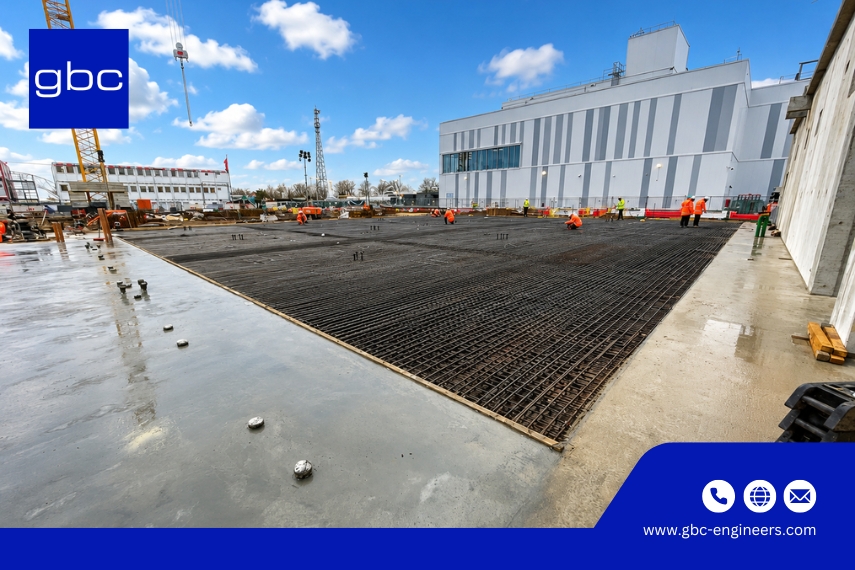
A raft foundation, sometimes called a mat foundation, is a continuous reinforced concrete slab placed directly under the full footprint of a building. Rather than concentrating load at individual column or wall positions, the raft spreads it across a large contact area with the soil.
Rafts work well when the near-surface soil has enough bearing capacity to carry a distributed load without excessive settlement, when loads are spread relatively evenly across the structure, and when the cost of individual pile foundations would be disproportionate. They also serve a dual function when a structural basement is needed: the raft and the basement slab become one element.
What is a pile foundation?
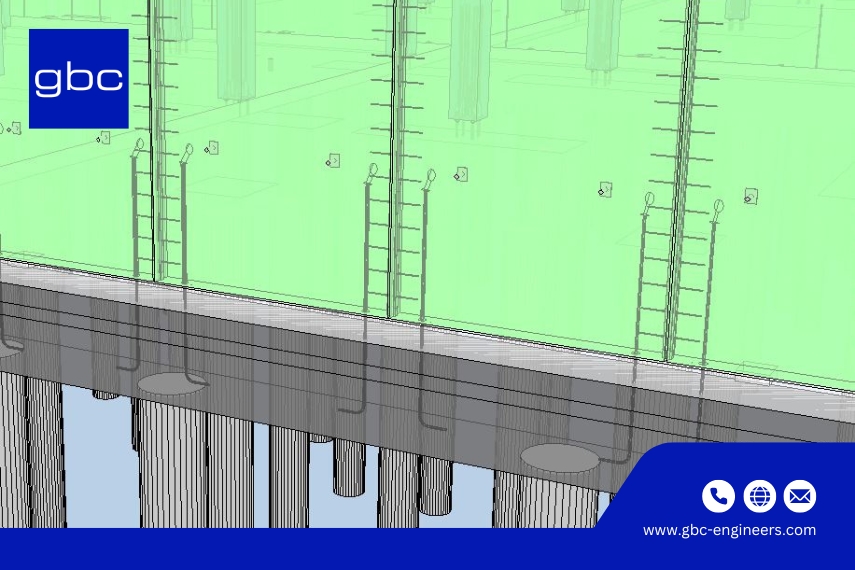
A pile foundation transfers the building's load directly to a stronger layer of soil or rock at depth, bypassing the weaker upper layers. The resistance comes from one of two sources: base resistance, where the pile bears onto a hard stratum at the tip, or shaft friction, where friction between the pile surface and the surrounding soil provides the capacity along its length.
Piles are the right answer when near-surface soils are too weak or too compressible to carry the loads through a shallow foundation. They are also the answer when settlement requirements are tight and the upper soil profile is unpredictable.
In some locations, there is no real decision to make. In Ho Chi Minh City, for example, the near-surface soils are soft enough that piles are almost always required. The question then becomes not whether to pile, but which pile system to use.
Read more: Soil Improvement vs. Piling: The Data Center Foundation Question That Swings Your CapEx
The conditions that decide your foundation strategy
With a ground investigation in hand, several conditions do most of the work in determining the right approach.
1. Soil bearing capacity near the surface
If the upper soil layers are strong enough to carry the building's loads without excessive settlement, a raft or shallow foundation is technically viable. If they are not, because the soil is loose, compressible, or filled, piles become necessary regardless of cost preference.
2. Settlement: total and differential
Total settlement matters less than differential settlement, which is how much different parts of the building sink relative to each other. For a logistics facility with high-bay racking, a few millimeters of differential settlement can tilt a rack and create an operational problem. For a data center, the same movement can misalign raised floors and disrupt cooling distribution. The settlement budget for large facilities is often tighter than clients expect, and it should be defined before the foundation strategy is chosen.
3. Load concentration and distribution
A raft handles distributed loads well. If a building has many walls and a relatively even load pattern, a raft can spread everything efficiently. If the structure generates concentrated column loads, as in industrial plants with heavy machinery, generator yards, or data center plant rooms, the raft may need to be very thick and heavily reinforced to transfer those loads. At a certain point, placing a pile directly under each concentrated load is more efficient than designing a slab around redistributing it.
4. Groundwater and contamination
Both affect cost in ways that are not always visible at tender. A high water table adds dewatering cost to any excavation. If the groundwater is contaminated, it may require treatment before discharge. Contaminated soil adds another layer: excavated material classified as hazardous waste is not a hauling cost, it is a disposal cost, and the difference can be significant.
5. Site access and local context
Some pile systems require large equipment. Some sites cannot accommodate it. A constrained urban plot, a site adjacent to existing structures, or a location with overhead restrictions will limit which pile systems are physically deployable. The noise and vibration of driven piles, acceptable on a rural industrial site, may be out of the question in a city center.
What is locally available also matters. If only one contractor offers the pile system your engineer prefers, that contractor will set the price. Keeping the pile type flexible enough that two or three contractors can bid gives the client more leverage.
How piles resist load: shaft friction and base resistance
A pile has two mechanisms for carrying the load above it. The first is base resistance: the pile bears onto a stronger layer at depth, and load transfers to that layer through compression at the tip. This works well when there is a well-defined hard stratum at reachable depth.
The second is shaft friction: the pile surface generates friction with the surrounding soil along its length. This is the dominant mechanism on sites where there is no strong base layer, where the soil is soft or variable from the surface down to significant depth.
A good geotechnical engineer will examine the site investigation, identify where the resistance is coming from, and select a pile system suited to either base resistance, shaft friction, or both. Some pile configurations can be modified to improve base resistance: bored piles can be underreamed to form a bell shape at depth, increasing the bearing area.
If you are not receiving this level of explanation, ask for it. The choice of pile system should follow from the source and depth of available resistance, not from what equipment the contractor has on site.
Read more: Why the Double-T Slab Is Winning the Race in Data Centre Floors
Types of pile systems
There is no single pile system that suits every project. The main categories in common use include:
- Bored piles: drilled and filled with reinforced concrete. Suitable for a wide range of conditions, but generate large volumes of spoil.
- Driven piles: steel or concrete piles hammered or hydraulically pressed into the ground. Fast and effective in appropriate soils. Driven with an impact hammer, they generate significant noise and vibration. Hydraulically pressed driven piles are common in urban environments where impact methods are not permitted.
- CFA (Continuous Flight Auger) piles: drilled and concreted in one continuous operation. Low vibration and efficient, but require specific machinery and soil conditions.
- Displacement piles, including Atlas and Frankie systems: install without excavating material, minimizing spoil generation.
The right system for a given project depends on the soil profile, the available resistance mechanism, site access, local contractor capability, and budget. An engineer who presents only one option has either done insufficient analysis or defaulted to what they know.
The piled raft: when both systems combine
For very large structures with high loads and tight settlement requirements, the two systems can be combined. In a piled raft, the slab distributes load across its contact area while piles beneath it provide additional resistance and control differential settlement.
The Burj Khalifa in Dubai is designed on a piled raft foundation. The system works, but it requires complex calculation: the interaction between the slab's contact pressure and the piles' load distribution cannot be modeled by simply adding two systems together. It is a combined structural response that requires specialist geotechnical design.
For most large-scale industrial or commercial facilities, a well-designed raft or a straightforward pile system is the right answer. The piled raft becomes relevant when loads are very high, the settlement budget is very tight, and the ground conditions are complex enough to warrant the additional analysis.
What clients often miss before committing
Several cost and risk items surface late in projects that should have been addressed at strategy stage.
Engineer capability. Not every structural engineer has experience designing pile foundations. Some default to shallow foundations or rafts because that is what they know how to calculate. The client rarely finds out, because no alternative is presented. If your engineer is offering only one foundation option for a large-scale facility without a comparison, ask why.
Construction sequence for large rafts. A large raft cannot be poured in one operation. The design must address how it is broken into sections, in what order those sections are cast, and how the joints between them are detailed. Poorly designed construction joints become waterproofing liabilities: water finds its way through them into the basement or floor buildup, and the cost of remedying that after construction is much higher than detailing it correctly from the start.
Waterproofing and performance requirements. What goes in the basement or below-grade space? Server infrastructure requires a different moisture specification than parking. These performance requirements need to be documented before the structural design is finalized, not discovered during fit-out.
Spoil disposal costs. Pile installation generates excavated material. On contaminated sites, that material is classified as hazardous waste, with a disposal cost several times higher than clean fill. This should be assessed before the foundation tender, ideally as part of site acquisition due diligence.
Questions you should ask your engineer
- "Walk me through why you chose this approach over the alternatives." The engineer should be able to lay out the chain of reasoning from the ground conditions to the recommendation. If the answer is essentially "this is what we always use," that is a flag.
- "Have you compared at least two foundation systems for this site?" For a large-scale facility, comparing options on cost, programme, CO₂, and risk is part of responsible design practice.
- "What settlement are you designing to, and is that tight enough for our operations?" The settlement limit in the design must match the operational tolerance of the equipment or racking the building will carry.
- "What happens if soil conditions at depth differ from the ground investigation?" The investigation is a sample, not a complete picture. There should be a contingency plan if pile lengths need adjustment or conditions are worse than expected.
- "Are there contamination risks that would affect spoil disposal or dewatering costs?" This should be established before the foundation tender, not after bids are returned.
Recommendations
Require the geotechnical engineer to present more than one foundation option. A single recommendation with no comparison gives the client no basis for evaluating whether the decision is technically and commercially sound.
Define settlement and level tolerance requirements before the foundation design is issued. The design must match the operational requirements of the building.
Do not defer the contamination and groundwater assessment. These are cost items that cannot be recovered once the project is committed to a strategy.
Choose the pile system partly on the basis of contractor competition. Three contractors offering technically similar systems is better than one contractor offering a proprietary system at their own price.
For any basement element, agree the waterproofing specification, and what "waterproof" means for that specific use, before the design is finalized.
Read more: The Construction Method Quietly Winning the AI Era
Working with gbc engineers
gbc engineers provides structural and geotechnical design review, foundation strategy assessment, and technical due diligence for industrial, commercial, and data center facilities. For clients evaluating foundation options or reviewing a design already in progress, we give clear, evidence-based technical input before decisions become expensive.
Conclusion
Foundation decisions are not made at tender. They are made in the early engineering stages, from a site investigation and a structural brief that may still have gaps. The choice between pile foundations and raft foundations, or a combination of both, follows from those conditions: not from a general preference, and not from what the engineer has designed most recently.
The cost of getting it right is the cost of a thorough site investigation, a competent geotechnical engineer, and a design process that presents options rather than defaults. gbc engineers works with clients and project teams to make sure that process happens before the programme commits.
Frequently Asked Questions
What is the difference between a raft foundation and a pile foundation?
A raft foundation is a continuous concrete slab that spreads the building's load across a large contact area with the soil. A pile foundation transfers load directly to a stronger layer at depth, using base resistance, shaft friction, or both. The right choice depends on soil bearing capacity, settlement requirements, load concentration, and site conditions.
Do raft foundations need piling?
Not always. On sites with strong near-surface soil and distributed loads, a raft alone is sufficient. When soil conditions are weaker, settlement requirements are tighter, or loads are very high, piles can be added beneath the raft. This combined system, called a piled raft foundation, requires more complex design than either approach on its own.
What are the main types of pile foundation?
The most common in large-scale facility construction are bored piles, driven piles, CFA (Continuous Flight Auger) piles, and displacement piles such as Atlas and Frankie systems. The right choice depends on soil conditions, the available resistance mechanism, site access, local contractor availability, and budget.
What are the disadvantages of pile foundations?
Piles cost more than shallow foundations on strong soil. They generate excavated spoil, which is a significant cost item on contaminated sites. They require specialist machinery and contractors, limiting pricing competition. Pile installation also sits on the critical path: unforeseen soil variability or pile length adjustments can delay the programme.
When should I compare foundation options for my project?
For any large-scale facility, always. The investment in comparing two or three foundation options is small relative to the cost and schedule risk of committing to the wrong one. If your engineer is presenting only one option, ask explicitly for alternatives to be developed and evaluated.
|
About us
gbc engineers
is an international engineering consultancy with offices in Germany, Poland, and South East Asia, having delivered 500+ projects worldwide. We provide services in structural engineering, data center design, infrastructure and bridge engineering, BIM & Scan-to-BIM, and construction management. Combining German engineering quality with international expertise, we achieve sustainable, safe, and efficient solutions for our clients.
|