Reviewed by Yoan Guyon, Managing Director at gbc engineers
For most of the past decade, hyperscale campuses and colocation buildings were treated as structural variants of the same problem. Different scales, different tenancy models, but the same basic structural logic. That assumption is breaking down, and the operators most exposed are often the ones who have not yet started the conversation.
This article examines where those paths are genuinely separating, and what that means for decisions operators face today.
Why hyperscale and colocation structural design shared the same rulebook
For most of the 2010s, a structural engineer could apply a broadly consistent template across both facility types. Rack loads clustered between 5 and 15 kilowatts, cooling followed similar air-based strategies, and floor loading requirements were comparable enough that local codes and site conditions were usually the main variables.
The difference was commercial, not structural. One building was designed around a single owner's expanding workload. The other was leased to whoever needed space next. The concrete and steel underneath were, broadly, the same challenge. AI changed that faster than most structural design cycles could absorb.
What the density shift is actually doing
Average rack densities are rising, though most production facilities still operate well below 8 kilowatts per rack. The structural challenge is the growing number of AI and high-performance computing zones where density assumptions have moved well beyond what most buildings were designed to carry. Racks running current AI accelerators are routinely specified at 40 to 80 kilowatts, with the next generation heading higher.
Colocation facilities serving general IT workloads are also seeing density rise, but more slowly and across a wider range of tenants. The structural gap between what hyperscale campuses and colocation buildings need from their structures gets wider each year. A floor system designed for standard IT equipment may not support a 100-kilowatt-per-rack AI hall.
Structural requirements have diverged. The question now is whether operators making brief decisions today are treating that as a fundamental design driver, or something to address later.
Read more: The Construction Method Quietly Winning the AI Era
6 ways the structural brief actually diverges
There are 6 structural factors where the two facility types part ways. Each is a practical decision point where applying the wrong brief creates lasting cost.
1. Floor load capacity
AI racks are rated in kilowatts, but what the structural slab carries is weight: rack equipment, cooling fluid, pipework and concentrated support loads. In high-density zones, those loads can reach 20 to 30 kilonewtons per square meter or higher (roughly 2 to 3 tonnes per square meter).
A standard office floor is designed for 2.5 to 5 kN/m² (under 0.5 tonnes per square meter), putting the most demanding AI zones 4 to 10 times beyond that. Colocation floors are typically specified at 12 to 15 kN/m² (about 1.2 to 1.5 tonnes per square meter), often with a raised floor that keeps the layout flexible as tenants change.
2. Column spacing and open floor area
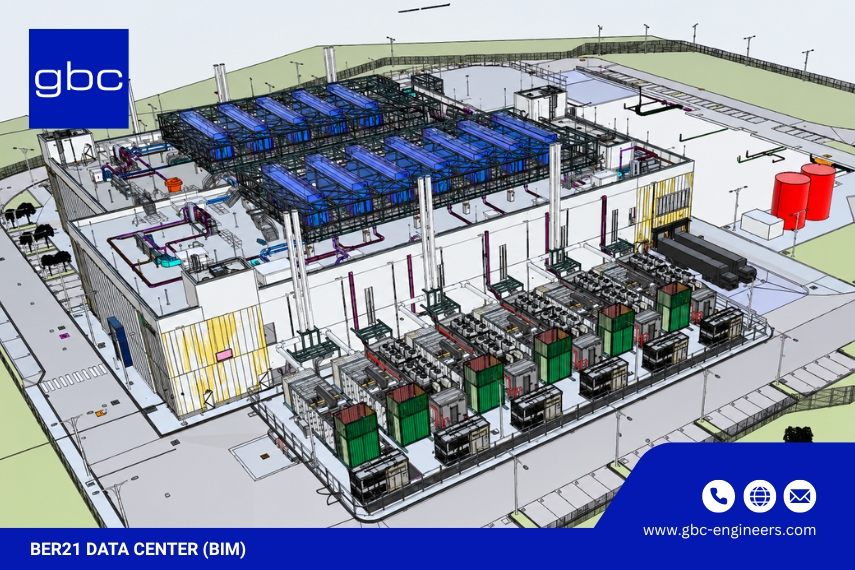
Hyperscale operators need to arrange tens of thousands of racks in long, uninterrupted rows. That means targeting column-free spans of 20 to 30 meters or more. Colocation operators, especially those building multi-story facilities in urban areas, typically work with tighter column grids of 9 to 15 meters. That still gives enough layout flexibility while keeping structural depths appropriate for buildings that go vertical rather than lateral.
3. Ceiling height
AI cooling at scale needs vertical clearance. Hot aisle containment, direct-to-chip cooling lines and dense cable runs all consume space above the racks. Hyperscale AI halls now typically specify 5 to 6 meters floor to ceiling. Most colocation buildings operate at 3.8 to 4.5 meters, adequate for most tenants, but a structural barrier for any tenant arriving with liquid-cooled AI equipment.
4. How the facility expands
Hyperscale campuses phase construction across years, adding halls to a master plan. That means embedding foundations and structural provisions for future halls into the initial design, well before those halls generate revenue. Colocation growth tends to go vertical and is often constrained by urban site boundaries, which calls for a different approach to phasing.
5. Where the cooling plant sits
Where the cooling plant sits is a site-specific call, not a fixed rule by facility type. Hyperscale campuses often have the land to keep cooling towers and dry coolers at grade; urban colocation sites tend to use rooftops, mechanical floors or compact external zones. Wherever it ends up, cooling towers, distribution units and pipework add significant structural load that needs to be designed in from the start. Retrofitting it after construction is expensive and disruptive.
6. Site conditions and ground constraints
Hyperscale campuses are often sited partly for geotechnical stability, reliable power and manageable climate, which filters out many structural risks before design even begins. Colocation facilities are frequently in dense urban markets where proximity to customers takes priority over ideal ground conditions, bringing a wider range of geotechnical variables into the brief.
The table below summarizes those six factors. It is a starting reference, not a fixed rule. Actual specifications depend on the operating model, site conditions and intended tenant profile.
|
What the structure must handle
|
Hyperscale data centers
|
Colocation (colo) centers
|
|
Scale and purpose
|
Single-tenant campus, typically 100+ MW
|
Multi-tenant building, typically 5 to 50 MW
|
|
Floor load capacity
|
20 to 30 kN/m², roughly 4 to 10 times a standard office floor
|
12 to 15 kN/m², mixed IT equipment
|
|
Open floor area
|
Column-free spans of 20 to 30 m or more
|
Column grid of 9 to 15 m
|
|
Ceiling height
|
5 to 6 m, with room for AI cooling and cable runs
|
3.8 to 4.5 m, adequate for most tenants
|
|
How the facility grows
|
New halls added to a campus master plan
|
Grows vertically within existing footprint
|
|
Site selection
|
Stable ground, reliable power, manageable climate
|
Urban sites near customers; varied ground conditions
|
|
Design life
|
20 to 30 years, one owner and one use case
|
Adapts to new tenants every 5 to 8 years
|
Note: kN/m² (kilonewtons per square meter) is the standard unit for measuring floor load capacity. A standard office floor is typically designed for 2.5 to 5 kN/m².
The question colocation operators are quietly wrestling with
Here is the tension: colocation is structurally defined by flexibility. A colocation building must work for the tenant arriving this year and the quite different one arriving in 5 years. That commercial promise is central to the product.
AI workloads are now testing whether that promise holds structurally. The highest-density AI tenants have requirements that start to look a lot like hyperscale: heavy floor loads, ceiling height for liquid cooling, column-free spans for layout flexibility. Specifying all of that into a colocation building is entirely possible. It is also expensive, and much of that cost covers structural capacity that most tenants will never use.
Operators who built to a higher spec in anticipation of AI demand are now either justified or sitting on expensive headroom, depending on how their market moved. Those who built to standard spec can serve most of their existing tenants without modification, but face a narrower range of options as high-density workloads grow.
Multi-tenant operators face tenant refresh cycles of 5 to 8 years on average. Each refresh can surface a structural mismatch: the arriving tenant's requirements may differ significantly from the one that left. Neither strategy was wrong when it was made. Both are now under pressure.
The table below maps structural strengths and risk areas for each facility type, and where misapplication of a brief creates the most cost.
|
|
Hyperscale data centers
|
Colocation (colo) centers
|
|
What the structure is built for
|
One operator, stable long-term workload
|
Multi-tenant product that must stay competitive as requirements shift
|
|
Structural strengths
|
AI density from day one; wide spans; cooling designed in; 20 to 30-year life
|
Lower cost for mixed loads; flexible across tenant types; viable multi-story
|
|
Risk if the spec does not match the facility type
|
Paying for floor loads, spans and height most tenants will never use
|
Under-built for AI: retrofitting structural capacity after construction is the costliest fix
|
|
What to watch between now and 2030
|
Liquid cooling raises the spec; carbon reporting demands justification for material choices
|
More existing facilities will need structural review before accepting high-density tenants
|
Note: This comparison applies to new-build and major refurbishment programs. Actual risk levels depend on the specific facility, existing structural capacity and intended operating model.
Where data center structural design is heading
3 structural trends point toward a wider gap between these markets over the next 5 to 10 years.
AI density has further to go
Rack densities above 100 kilowatts are already in procurement for the next generation of AI hardware. Within the design life of facilities commissioned today, that level may become common across AI environments, even if it stays above the market average. The structural decisions locked in now will be tested against loads that do not yet exist. Operators building to current density norms without headroom are narrowing their options faster than the procurement cycle makes visible.
Liquid cooling will change what structures need to carry
Liquid cooling is moving from specialist deployments into standard production design, with direct-to-chip cooling already operating commercially in hyperscale AI halls and immersion cooling following. Both require structural provisions most existing buildings do not have: load-rated slabs for fluid weight, containment for leakage risk, mechanical room capacity for distribution equipment.
In a new build, those are straightforward to include. In an existing facility, a structural assessment comes first, and for many colocation assets built before the AI-density shift, that assessment is overdue.
Read more: Air vs Liquid Cooling in Data Centers: When Should You Make the Switch?
Sustainability reporting will surface the differences
Sustainability reporting is making structural decisions more visible. In Europe, Commission Delegated Regulation (EU) 2024/1364 sets energy performance and reporting requirements for data centers. Beyond compliance, whole-life carbon assessments are creating real pressure to justify material-intensive choices: heavier floor loads, longer spans, additional headroom. Operators who can justify those decisions operationally are better placed than those who cannot.
Conclusion
The structural brief has always followed commercial logic. That logic is now increasingly driven by workloads that did not exist 3 years ago. The gap between what hyperscale campuses and colocation buildings need structurally is widening, and the decisions made at the brief stage today will shape how much flexibility operators have for the rest of the facility's life.
For developers, operators and consultants working through this: the right question is what the facility's realistic operating model looks like across its full design life, and whether the structural brief reflects that. Getting that question on the table early is where structural input makes the most difference.
Frequently asked questions
What is a hyperscale data center?
A hyperscale data center is a large facility built and operated by a single organization for its own workloads. The main operators are major cloud and technology companies: AWS, Microsoft Azure, Google Cloud, Meta and Alibaba Cloud. Their campuses can exceed 100 megawatts of IT load and are purpose-built for a specific IT and cooling strategy, scaled across multiple halls or campus buildings.
Can a colocation facility handle hyperscale AI workloads?
Not without a structural assessment first. Where the gap between a building's existing spec and AI-density requirements is large, new-build is generally more cost-effective than retrofit. Minor upgrades in specific zones with spare structural capacity are more achievable. Either way, a structural survey is the right starting point.
Does hyperscale structural design cost more than colocation?
Usually yes, though not by as much as the spec differences suggest. Heavy floor loads, wide spans and extra ceiling height actually add cost. The bigger risk is misspecification in either direction: over-building a colocation facility wastes capital, and under-building a hyperscale AI hall leads to expensive retrofit. The goal is a brief matched to the operating model.
|
About us
gbc engineers
is an international engineering consultancy with offices in Germany, Poland, and South East Asia, having delivered 500+ projects worldwide. We provide services in structural engineering, data center design, infrastructure and bridge engineering, BIM & Scan-to-BIM, and construction management. Combining German engineering quality with international expertise, we achieve sustainable, safe, and efficient solutions for our clients.
|