Reviewed by Yoan Guyon, Managing Director at gbc engineers
Three bridges, three continents, three decades apart. The New York State Thruway bridge over Schoharie Creek, the Malahide Viaduct in Ireland and the Hintze Ribeiro Bridge in Portugal all failed for the same underlying reason. In each case, the original design was not the primary problem. The foundations grew more vulnerable as surrounding conditions changed and protective measures proved insufficient.
gbc engineers examines these three cases to explore how scour developed and what lessons they offer for bridge engineering today.
What is scour, and why does it undermine bridges?
Scour happens when moving water washes away soil and sediment around bridge foundations, reducing the support beneath piers and making the structure unstable.
Bridges are protected by placing foundations deep below the expected scour level, or by adding heavy stone, known as riprap, around the base to limit erosion.
River conditions change over time: flood intensity, water flow and riverbed levels can all shift, so protection that was once sufficient may no longer be enough. The three cases below show how this gradual change becomes a critical structural risk.
Read more: Haldensprung Bridge: Innovation in Modern Bridge Design
Schoharie Creek Bridge, USA: failure caused by loss of scour protection
The New York State Thruway bridge over Schoharie Creek, near Amsterdam, New York, opened in 1954. Its piers sat on shallow spread footings in erodible soil, protected by riprap. On April 5, 1987, heavy rain and snowmelt caused a major flood, later estimated by the US Geological Survey as roughly a 70-year event. Pier 3 collapsed, followed by Pier 2 about 90 minutes later.
The National Transportation Safety Board identified the probable cause as the Thruway Authority's failure to maintain enough riprap around the piers, which let floodwater erode the soil beneath the spread footings. The investigation also found unclear construction requirements, limited underwater inspection and a lack of structural redundancy: once a pier lost support, the bridge could not redistribute the load. The failure underlines why scour protection needs inspection and maintenance throughout a bridge's service life.
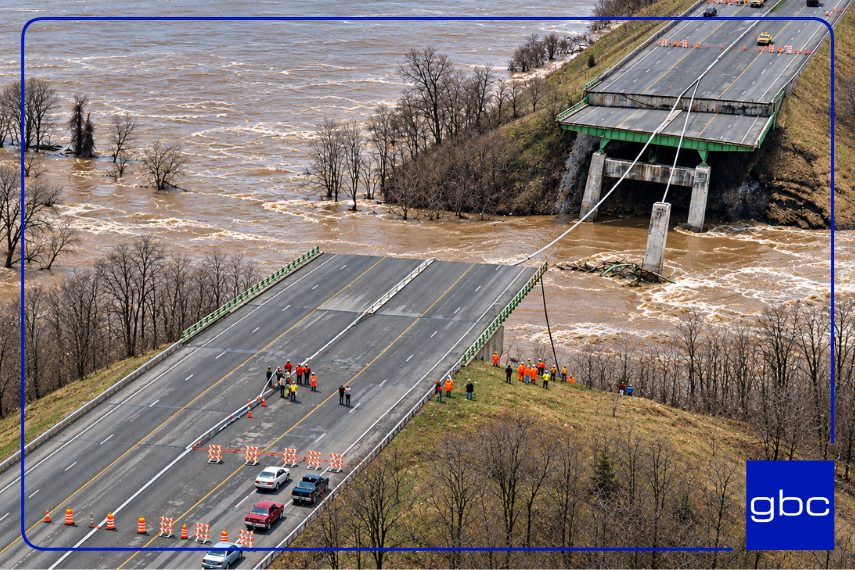
Picture: Schoharie Creek Bridge, USA. Source: National Transportation Safety Board.
Read more: 5 Signs Your Infrastructure Bridge or Building Needs Inspection
Hintze Ribeiro Bridge, Portugal: weakened by riverbed erosion
The Hintze Ribeiro Bridge was built in 1886 across the Douro River near Porto. Some piers were protected by rockfill, while Piers 4 and 5 relied on a natural sand deposit along the riverbank, which shielded the foundations from the main river flow for decades.
From the mid-1970s, large-scale sand extraction and dredging upstream gradually changed the riverbed. Near Pier 4, the riverbed had already dropped by about 11.5 meters between 1913 and 1982, and continued to fall afterward. As the sand deposit disappeared, Pier 4 grew increasingly exposed to scour.
The bridge collapsed on March 4, 2001, after the fifth in a series of major floods since December 2000. The research in 2021 found the main causes were 25 years of sand dredging combined with erosion from the five consecutive floods, acting on a foundation already weakened by decades of riverbed change. The case shows why human activity such as sand extraction must be considered throughout a bridge's service life.
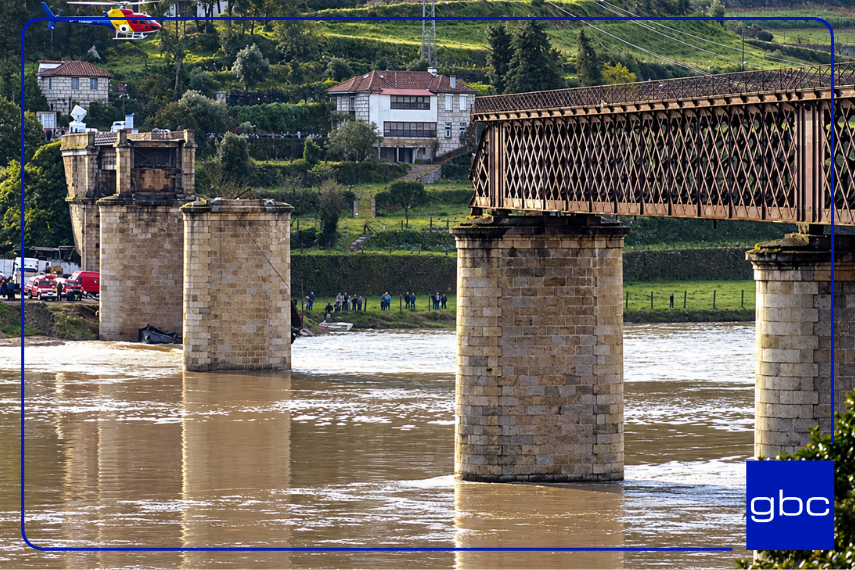
Picture: Hintze Ribeiro Bridge, Portugal. Source: Simão Antunes Do Carmo, J. (2021).
Malahide Viaduct, Ireland: failed after years of scour from tidal flow
The Malahide Viaduct is a railway bridge on the Dublin to Belfast line, crossing the Broadmeadow Estuary in Ireland. Its piers were protected by a rock-armored weir designed to control tidal flow and reduce erosion around the foundations.
The viaduct collapsed on August 21, 2009. Unlike the other two cases, there was no storm or flood that day. The weather was dry, and the collapse happened close to low tide, when the tidal range was among the largest of the month. This meant the failure was linked not to a single extreme event, but to regular tidal currents.
Ireland's Railway Accident Investigation Unit found that scour had weakened the weir around Pier 4. What makes the case more striking is that the warning signs were not new. A 1997 inspection had already identified scour at Pier 4 and noted that the rock armor was "too light for the job", but no action was taken. Just three days before the collapse, another inspection also failed to identify the visible defects. Investigators found that knowledge of the Malahide Viaduct had also been lost as experienced staff left.
The Malahide Viaduct shows that scour does not always happen suddenly. It can develop gradually under normal conditions, making early warnings and proper follow-up essential.
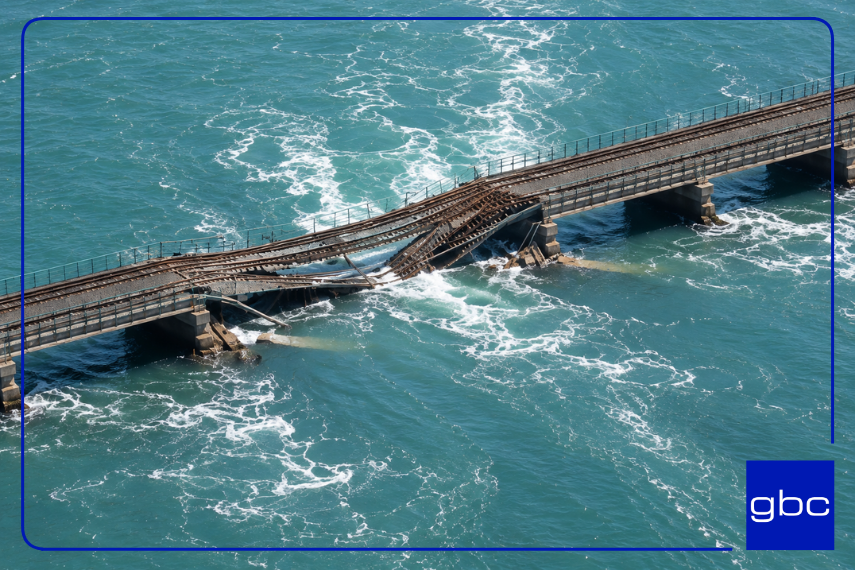
Picture: Malahide Viaduct, Ireland. Source: Railway Accident Investigation Unit.
What can we learn from these bridge failures?
Scour was the common mechanism in all three failures, but each case points to a different lesson.
- Schoharie Creek shows that scour protection must be inspected and maintained throughout a bridge's life.
- Hintze Ribeiro shows that foundation safety depends on how the river itself changes over time, including changes caused by dredging or other upstream activity.
- Malahide shows that technical knowledge must also be preserved, since known risks can be missed when earlier findings are not carried forward.
At gbc engineers, structural engineering is supported by BIM-based documentation and coordinated asset information that help preserve design intent, inspection records and technical knowledge throughout a structure's life.
Read more: Railway Bridge Renewal in Niederbiegen | gbc engineers
Conclusion
None of the three failures began with a design error. In each case, natural conditions changed while maintenance, inspection or asset records failed to keep pace. Long-term safety depends on continuous inspection, updated risk assessment and reliable documentation. gbc engineers supports this with structural engineering and BIM-based documentation that keeps asset information usable throughout its life.
Frequently asked questions
What are the 7 types of bridge inspection?
Bridges are commonly checked under seven categories: initial, routine, in-depth, damage, special, fracture-critical and underwater inspection. Routine inspections cover the whole structure on schedule, while the others target a specific concern such as scour.
How do engineers test bridges?
Engineers use visual inspections and non-destructive tests to check for both visible and hidden problems. They can also carry out load tests to see how a bridge responds under a known load. Permanent sensors can monitor strain and vibration over time, helping engineers spot changes between inspections.
How do engineers evaluate a bridge design?
A design evaluation checks the loads the bridge must carry, including hydraulic and scour loads, a structural analysis confirming every member has enough capacity, and compliance with the governing design code, Eurocode and DIN standards in Germany. Redundancy and independent peer review are standard checks before construction.
What is the difference between bridge inspection and structural health monitoring?
Inspection is a scheduled, human-led check at set intervals. Structural health monitoring uses permanent sensors to track the structure continuously and flag changes between inspections. Combining the two gives the most complete picture, since neither replaces the other.
What is a bridge's design life, and does it mean the bridge fails after that time?
Design life is the period a bridge is designed to perform safely, often 75 to 100 years, assuming normal maintenance. Reaching that date does not mean the bridge suddenly fails: a well-maintained bridge can exceed it, while deferred maintenance can cause problems well before it ends.
How do engineers decide whether to repair, retrofit or replace an aging bridge?
The decision depends on the bridge's condition, expected remaining service life, repair costs and current load requirements. Engineers compare whether repairing or strengthening the existing structure can safely extend its life, or whether replacing it would be more practical and cost-effective.
|
About us
gbc engineers
is an international engineering consultancy with offices in Germany, Poland, and South East Asia, having delivered 500+ projects worldwide. We provide services in structural engineering, data center design, infrastructure and bridge engineering, BIM & Scan-to-BIM, and construction management. Combining German engineering quality with international expertise, we achieve sustainable, safe, and efficient solutions for our clients.
|