In the competitive landscape of commercial real estate, a building’s success is often measured by its aesthetics and location. However, for property developers and building owners, the true value of an asset lies beneath the surface. While building codes provide a non-negotiable baseline for safety, the most successful projects are those where structural engineering for office buildings is leveraged as a strategic tool for value creation.
At gbc engineers, we believe that structural design should do more than just "hold up the floor." It should optimize the usable area, reduce lifecycle costs, and provide the flexibility needed for a building to evolve over decades. This guide explores how sophisticated engineering transforms office buildings from simple compliance-driven structures into high-performance assets.
What Does Structural Engineering Mean for Office Buildings?
For a modern office complex, structural engineering is the invisible backbone that dictates every other aspect of the project. It is the science of balancing gravity, wind, and seismic forces while meeting the architectural vision and the developer's budget.
In the context of commercial office structural engineering, this means more than just calculating beams and columns. It involves:
- Spatial Optimization: Engineering the "skeleton" to minimize the footprint of vertical supports. By reducing the number or size of columns, engineers increase the Net Lettable Area (NLA), which directly impacts the building’s revenue-generating potential.
- Integration of Systems: Coordinating with MEP specialists to ensure that structural zones and service zones (like HVAC ducting) work in harmony, preventing wasted vertical space and reducing floor-to-floor heights.
- Constructability: Selecting materials and methods that align with the local labor market and supply chain, ensuring the project moves from the drawing board to completion without unnecessary delays.
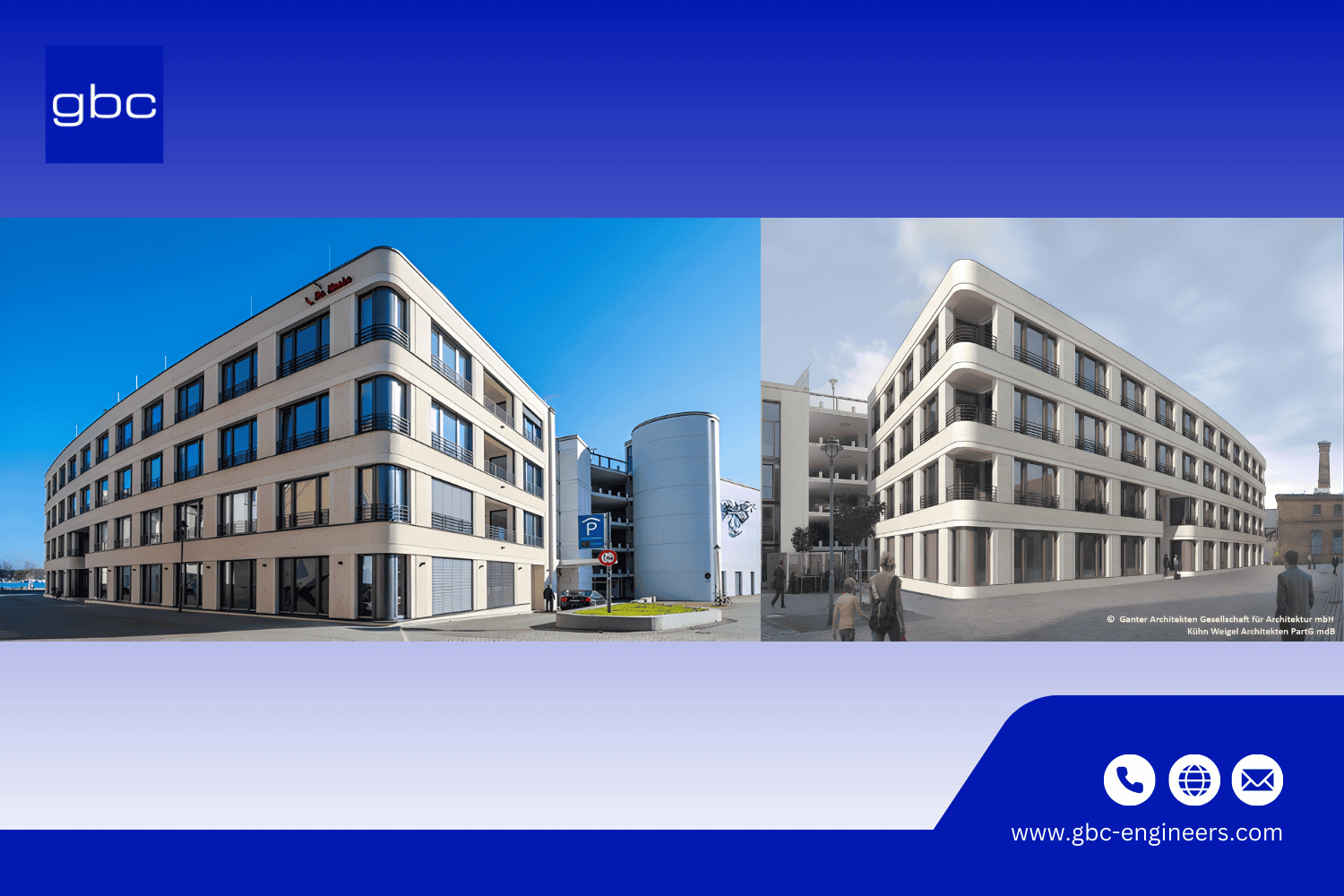
At gbc engineers, our approach integrates advanced digital tools like BIM (Building Information Modeling) early in the process. This allows us to visualize complex geometries and detect potential clashes before a single brick is laid, as seen in our work on projects like the Office Building Schiffbauergasse in Potsdam.
Why Structural Engineering Matters Beyond Code Compliance
Code compliance ensures that a building is safe for occupancy, but it does not guarantee that the building is a "good" investment or a "productive" workspace. Engineering "beyond code" is where technical expertise adds the most value for building owners and asset managers.
1. Vibration and Comfort (Footfall Dynamics)
Modern offices often feature open-plan layouts and lightweight flooring systems. While code-compliant, these can sometimes be prone to annoying vibrations from walking or heavy machinery. Superior engineering analyzes footfall dynamics to ensure a quiet, "solid" feel that premium tenants expect.
2. Resilience and Future-Proofing
A building designed strictly to code might satisfy today's requirements but fail to accommodate tomorrow's needs. By designing for slightly higher load tolerances in specific zones, we allow for the future installation of server rooms, heavy filing systems, or even rooftop gardens without the need for costly retrofitting later.
3. Sustainability and Embodied Carbon
As ESG (Environmental, Social, and Governance) criteria become central to real estate investment, reducing a building's carbon footprint is essential. Structural engineers can significantly reduce embodied carbon by optimizing material usage (e.g., high-strength concrete or recycled steel) and reducing waste.
4. Marketability
High-performance structures attract high-quality tenants. Features like column-free spans of 12-15 meters allow for creative fit-outs that are impossible in buildings with traditional, dense column grids.
Common Structural Systems Used in Office Buildings
Choosing the right structural system is one of the most critical decisions in the early design phase. The choice depends on the building height, local material costs, and the desired speed of construction.
| Steel Frame |
High-rise & Fast-track |
Speed of erection, lightweight, long spans. |
Requires fireproofing, higher material cost. |
| Reinforced Concrete |
Mid-rise & Residential-Office |
Excellent fire resistance, shallow floor depths. |
Slower construction; heavier foundations. |
| Post-Tensioned (PT) Concrete |
Large open-plan offices |
Very thin slabs, maximum floor-to-ceiling height. |
Complex to modify or drill into later. |
| Hybrid (Steel/Concrete) |
Modern Grade-A Offices |
Combines the stiffness of a concrete core with the speed of steel. |
Requires precise coordination between trades. |
Utilizing flexible office building structures like long-span steel or PT concrete allows for column-free distances of 12 to 15 meters. This freedom allows architects to create expansive, unobstructed views that are highly attractive to modern tech and creative firms.
For many of our international projects, gbc engineers often recommends hybrid systems. For instance, our expertise in Steel-Concrete Hybrid Systems allows us to deliver the lateral stability of concrete with the spatial flexibility of steel.
How Loads and Usage Shape Office Building Structures
Every office building must navigate a complex set of "loads" that dictate its final form. Understanding these is vital for project managers and architects when defining the building's brief.
Gravity Loads (Vertical Forces)
- Dead Loads: The weight of the building itself (slabs, beams, facade).
- Live Loads: The weight of people, furniture, and partitions. Modern office building structural design must account for high-density occupancy trends where more employees occupy smaller, "agile" workspaces compared to traditional office layouts.
Lateral Loads (Horizontal Forces)
- Wind Loads: As buildings increase in height, wind becomes the dominant force. The structure must be stiff enough to prevent "sway" that could cause discomfort to occupants on higher floors or cause the facade system to fail.
- Seismic Loads: In earthquake-prone regions, the structure must be designed to dissipate energy safely through ductile detailing and specialized bracing.
Specialized Usage Loads
Different areas of an office building require different load capacities. A standard office floor might be designed for 2.5 to 3.0 kN/sqm, but a dedicated data center room or a rooftop mechanical plant room might require 7.5 kN/sqm or more. Early involvement of gbc engineers ensures these zones are identified and reinforced efficiently without over-engineering the entire floor plate.
Cost, Flexibility, and Long-Term Performance
For building owners and investors, the "Golden Triangle" of structural engineering is the balance between cost-efficient structural design, flexible office building structures, and long-term structural performance.
Cost Efficiency Through Optimization
A common mistake in commercial projects is over-specifying materials to compensate for a lack of detailed analysis. Sophisticated engineering uses digital twins and advanced software to optimize rebar and steel sections. Saving even 5% on structural materials can translate into hundreds of thousands of dollars in a large-scale project without compromising safety.
Flexibility for Adaptive Reuse
The average lifespan of an office fit-out is 7 to 10 years, but the structure must last 50 to 100 years. Flexible office building structures are designed with "soft spots" for future internal stairs or service risers. This adaptability makes the building significantly more attractive to long-term tenants and easier to repurpose if market demands change.
Maintaining Performance
Long-term structural performance is ensured through rigorous site supervision. At gbc engineers, we provide site management and construction supervision to ensure that the "as-built" reality matches the design precision. This reduces the risk of settlement cracks, leaks, or structural degradation that could plague asset managers years down the line.
When to Involve Structural Engineers in Office Projects
The most expensive mistakes in property development often happen in the first 10% of the project's timeline. Waiting until the architectural concept is finished to bring in the structural team often leads to "forced" engineering solutions that are both expensive and inefficient.
The Ideal Timeline:
- Feasibility & Pre-Design: Assess site conditions and foundation requirements early. A technical due diligence report can identify soil issues or height restrictions before the land is even purchased.
- Schematic Design: This is where we define the column grid. Collaborative sessions between architects and structural engineers here can maximize the floor area.
- Detailed Design & BIM: Using digital twins to ensure perfect coordination with MEP services, reducing "change orders" during construction.
- Construction Phase: Ongoing site management and quality supervision ensure that the "as-built" reality matches the design precision.
Why Choose gbc engineers?
As a German-founded engineering firm with a global presence, gbc engineers combines European precision with local market expertise in regions like Vietnam, Cambodia, Poland, and Germany. Whether you are an architect looking for a technical partner to realize a bold vision, or a developer seeking a cost-efficient structural design, our team provides the clarity and reliability your project needs.
From the Allianz Headquarter in Berlin to complex towers in Southeast Asia, our portfolio demonstrates a commitment to engineering that serves the business goals of our clients.
Conclusion
Engineering for the modern office is no longer just about meeting minimum safety standards. It is about creating a resilient, flexible, and efficient environment that serves the needs of investors and tenants alike. From optimizing column placement to reducing embodied carbon, every structural decision impacts the commercial viability of the asset.
At gbc engineers, our international expertise allows us to deliver projects that go well beyond code compliance. Whether we are providing site management and construction supervision or working on complex office building projects, our focus remains on providing cost-efficient structural design that stands the test of time.
Would you like gbc engineers to review your current office building concept for structural optimization? Our team is ready to provide a preliminary assessment or a BIM-driven feasibility study to help you maximize the value of your next commercial project. Contact us today to learn how we can bring your vision to life.
|
About us
gbc engineers
is an international engineering consultancy with offices in Germany, Poland, and South East Asia, having delivered 500+ projects worldwide. We provide services in structural engineering, data center design, infrastructure and bridge engineering, BIM & Scan-to-BIM, and construction management. Combining German engineering quality with international expertise, we achieve sustainable, safe, and efficient solutions for our clients.
|