Reviewed by Yoan Guyon, Managing Director at gbc engineers
Is liquid cooling right for your data center, or is air cooling still the better choice? As AI workloads push rack power densities to levels that conventional air-cooling systems struggle to handle, this has become one of the most important questions in data center design today.
The good news is that there is no single right answer. For most enterprise data centers, air cooling remains a reliable and cost-effective solution. For high-density AI and HPC environments, liquid cooling is quickly becoming essential.
This guide from gbc engineers breaks down how each cooling system works, when liquid cooling makes sense, and when air cooling is still the smarter choice for your facility.
How do air cooling and liquid cooling work in data centers?
Air cooling systems in data centers
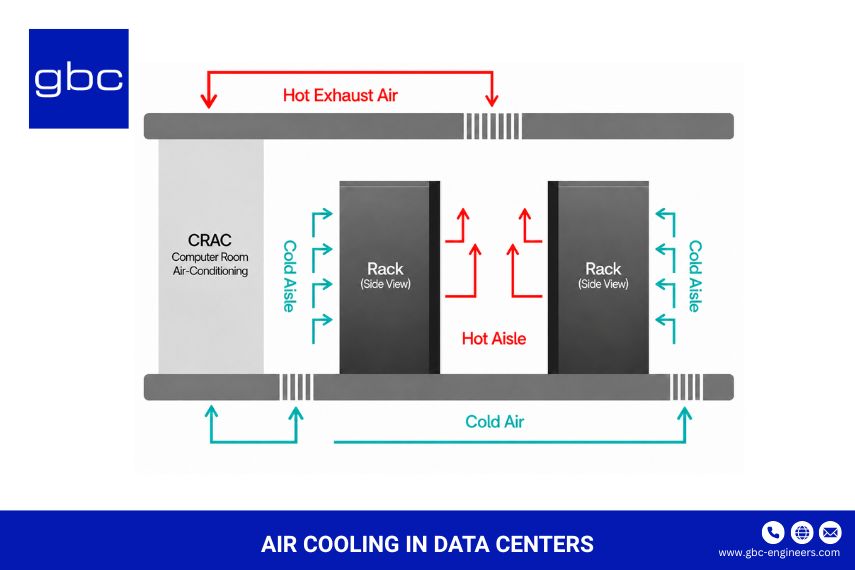
Air cooling circulates conditioned air through the data center to absorb and remove heat from IT equipment. The typical air-cooling architecture for a data center includes:
- Computer Room Air Conditioning (CRAC) or Computer Room Air Handler (CRAH) units positioned around or within the white space.
- Raised floor plenums that distribute cold air to server inlet grilles.
- Hot-aisle/cold-aisle containment arrangements that separate supply and return airstreams.
- Precision cooling units, in-row coolers, or overhead units for supplemental density management.
Air has a specific heat capacity of approximately 1.005 kJ/kg·K, which is significantly lower than water. This limits how much heat can be transported per unit of airflow, making high-density deployments increasingly expensive and space-intensive to cool with air alone.
Liquid cooling systems in data centers
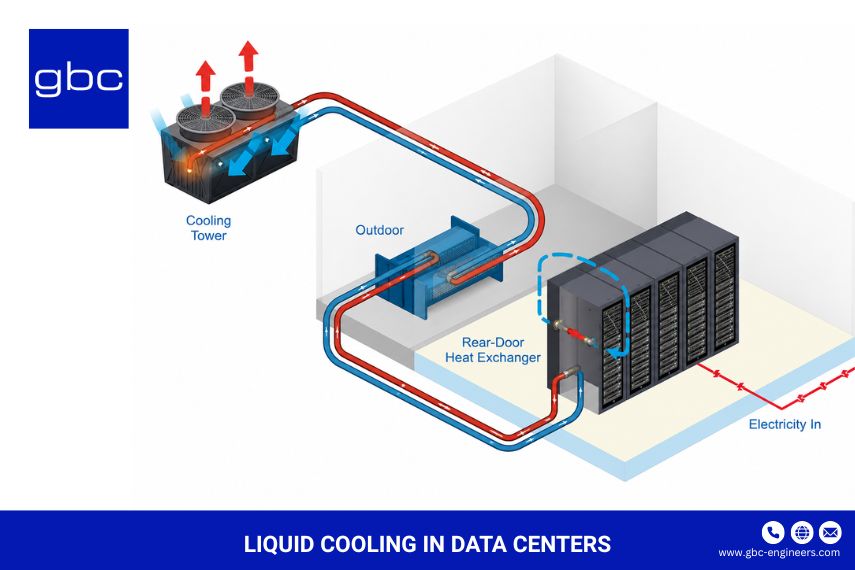
Liquid cooling uses water or specialized fluids, which carry heat roughly four times more efficiently than air, to remove heat at greater densities and with lower energy consumption. The three main technologies deployed in data centers today are:
- Direct liquid cooling (DLC) / Cold plates: Coolant circulates through cold plates mounted directly on processors and GPUs, removing heat conductively without air as an intermediary. Supports rack densities of 30 to 100+ kW.
- Rear-door heat exchangers (RDHx): A liquid-cooled heat exchanger fitted to the rear of a standard rack intercepts hot exhaust air before it re-enters the room. No server modifications are required. Best suited for 10 to 30 kW racks.
- Immersion cooling: Servers are fully submerged in dielectric (non-conductive) fluid. Supports extreme densities exceeding 100 kW per tank and eliminates server fans entirely.
Read more: Data Center Cooling: How Modern Systems Improve Efficiency and Sustainability
What are the key differences between air cooling and liquid cooling?
The table below summarizes the principal engineering and operational differences between conventional air cooling and the main liquid cooling modalities available for data center applications.
|
Criteria
|
Air cooling
|
Rear-Door HX
|
Direct liquid cooling (DLC)
|
Immersion cooling
|
|
Rack density supported
|
Up to 15 kW
|
10 to 30 kW
|
30 to 100+ kW
|
100+ kW per tank
|
|
Typical PUE range
|
1.4 to 1.8
|
1.2 to 1.5
|
1.05 to 1.15
|
1.02 to 1.08
|
|
Capital cost (relative)
|
Low
|
Medium
|
Medium to High
|
High
|
|
Server modification needed?
|
No
|
No
|
Yes (cold plates)
|
Yes (submersion)
|
|
Retrofit to existing facility?
|
Yes
|
Yes
|
Partially
|
Limited
|
|
Best suited for
|
Standard enterprise
|
Mid-density upgrades
|
AI / HPC clusters
|
Ultra-dense AI / research
|
When should you consider liquid cooling? Five decision triggers
There is no single threshold that applies universally. Based on gbc engineers' experience across data center feasibility, design, and commissioning projects, five clear indicators suggest a liquid cooling strategy is warranted.
1. Rack power density exceeds 15 to 20 kW
This is the most technically definitive trigger. ASHRAE TC 9.9 (2023) classifies racks above 20 kW as high density and recommends water-cooled solutions for such environments. AI accelerator hardware, such as the NVIDIA H100 (700 W per GPU) or AMD Instinct MI300X, routinely places server trays well beyond this threshold. A single NVIDIA GB200 NVL72 rack draws approximately 120 kW, making air cooling physically inadequate for such deployments.
2. PUE targets cannot be met with air cooling
The global average data center PUE was 1.58 in 2023 (Uptime Institute). Liquid cooling, combined with free-cooling or adiabatic design, routinely achieves PUEs of 1.02 to 1.15, delivering 20 to 40% reductions in annual cooling energy costs at high densities. For operators with public sustainability targets or regulatory obligations, this efficiency gap becomes a strategic issue.
3. AI and HPC workloads are expanding
GPU-accelerated AI infrastructure is the primary market driver for liquid cooling adoption globally. According to McKinsey and Company (2024), AI-related data center electricity demand in the US alone could reach 11.7% of national power consumption by 2030. If your roadmap includes AI training, large language model inferencing, or high-performance computing workloads, liquid cooling should be part of your design plans now, not as a retrofit.
4. Floor space or power capacity is constrained
Immersion cooling in particular allows significantly more compute capacity per square meter of floor space than conventional air-cooled rack rows. For co-location facilities or enterprise data centers with fixed building envelopes, this can unlock meaningful capacity expansion without structural modifications or building extensions.
5. Sustainability and regulatory commitments
The EU Energy Efficiency Directive (EED) recast and corporate net-zero commitments are increasing pressure on data center operators to demonstrate measurable efficiency improvements. Liquid cooling, especially when paired with waste heat recovery programmes, directly supports PUE improvement and broader ESG reporting objectives. Several European district heating networks have already received recovered waste heat from liquid-cooled data centers.
Recommendation: Before committing to a cooling upgrade, commission a thermal audit and workload density model of your current and projected facility. A phased hybrid strategy, retaining air cooling for standard workloads while deploying liquid cooling for high-density zones, typically delivers the best balance of performance, cost, and operational risk.
Why does air cooling still matter in data centers?
Air cooling is not a legacy technology. It is the right technology for a large proportion of today's data center environments. For standard enterprise workloads at densities below 10 to 15 kW per rack, its advantages remain compelling:
- Lower capital and operational cost, with no specialist fluid circuits, secondary loops, or leak detection infrastructure required.
- Operational simplicity, with no water near IT equipment, reducing risk and maintenance complexity.
- Universal hardware compatibility, as all commercially available servers are designed and warranted for air cooling.
- Mature supply chain with well-established service networks, spare parts, and trained engineering resources.
For organizations not planning to deploy GPU-intensive AI workloads in the near term, investing in liquid cooling infrastructure may not be financially justified. At gbc engineers, our view is clear: the decision should always be driven by engineering evidence and workload data, not market trends or vendor pressure.
How do air cooling and liquid cooling compare in cost?
The table below provides indicative cost benchmarks for different cooling approaches at a representative 1 MW IT load data center. All figures are indicative and will vary significantly by location, facility type, and scope.
|
Cost category
|
Air cooling
|
Hybrid (Air + DLC)
|
Full DLC
|
Immersion
|
|
Capex (cooling infrastructure)
|
Baseline
|
+30 to 50%
|
+60 to 90%
|
+100 to 150%
|
|
Opex (annual energy, cooling)
|
Baseline
|
-15 to 25%
|
-30 to 45%
|
-40 to 55%
|
|
Floor space required
|
Baseline
|
Similar
|
-15 to 25%
|
-30 to 50%
|
|
Payback period (energy savings)
|
N/A
|
3 to 6 years
|
4 to 8 years
|
5 to 10 years
|
|
Typical PUE achieved
|
1.4 to 1.8
|
1.2 to 1.4
|
1.05 to 1.15
|
1.02 to 1.08
|
A practical decision framework for data center operators
The following structured process reflects gbc engineers' approach across data center feasibility, design, and commissioning projects. Applying it at the design stage, rather than reactively, consistently delivers better outcomes on cost, timeline, and risk.
- Audit current and projected rack power densities across all IT zones.
- Identify high-density zones exceeding 10 to 15 kW per rack that may require supplemental or dedicated cooling.
- Assess facility constraints: available power, floor loading, water supply access, and building structure.
- Model the financial case, including capex, opex, PUE improvement, and payback period for each cooling option.
- Review your workload roadmap for AI, HPC, or GPU workload growth over the next 3 to 5 years.
- Define your strategy as air-only, hybrid, or liquid-primary, then develop a phased implementation plan aligned with hardware refresh cycles and capital budgets.
Read more: Typical Data Center Layout: Core Components and Infrastructure 2026
Conclusion
Air cooling and liquid cooling are not competing solutions. They are complementary technologies suited to different workload environments. Air cooling remains the optimal choice for standard enterprise deployments. Liquid cooling has become essential for AI infrastructure, high-performance computing, and any facility planning for densities above 20 kW per rack.
The critical step is accurate workload modeling. Organizations that understand their current and future density requirements and plan their cooling infrastructure accordingly will be better positioned to control costs, meet efficiency targets, and scale with confidence.
Frequently asked questions
Here are quick answers to the most common questions about modern data center cooling:
What is the difference between air cooling and liquid cooling in a data center?
Air cooling uses circulated conditioned air to remove heat from servers. Liquid cooling uses water or dielectric fluids, which carry heat approximately four times more efficiently than air. Liquid cooling supports significantly higher rack densities and lower PUE values but requires more complex infrastructure and higher initial investment. For standard enterprise workloads below 15 kW per rack, air cooling remains the most cost-effective solution.
When should a data center switch to liquid cooling?
Liquid cooling becomes necessary when rack power densities exceed 15 to 20 kW per rack, when PUE targets cannot be achieved with air cooling alone, or when AI, GPU, or HPC workloads are being deployed. Sustainability commitments, floor space constraints, and regulatory efficiency requirements are also common drivers for making the transition.
Is air cooling still viable for modern data centers?
Yes. For standard enterprise workloads at densities below 10 to 15 kW per rack, air cooling remains an effective and cost-efficient solution. It offers lower capital cost, simpler operations, and universal hardware compatibility. Most data centers worldwide still rely on air cooling for most of their IT load.
What is direct liquid cooling (DLC) in a data center?
Direct liquid cooling (DLC) circulates coolants through cold plates mounted on processors and GPUs, removing heat conductively without air as an intermediary. DLC systems support rack densities of 30 to 100+ kW and are the most widely deployed liquid cooling technology for AI and high-density data center environments.
How does liquid cooling improve data center PUE?
Liquid cooling reduces PUE by eliminating energy-intensive compressor-based cooling equipment and enabling economizer (free-cooling) operation for a greater proportion of annual hours. Best-in-class liquid-cooled facilities achieve PUEs of 1.02 to 1.10, compared to 1.4 to 1.8 for conventional air-cooled designs, representing a significant reduction in cooling energy costs.
Can liquid cooling be retrofitted to an existing air-cooled data center?
Yes, in most cases. Rear-door heat exchangers are the simplest retrofit option and require no server modifications. Direct liquid cooling can be integrated into existing facilities but requires new secondary coolant circuits and a hardware compatibility review. Full immersion cooling is most practical in new builds or major refurbishments due to its structural and spatial requirements.
What are the risks of liquid cooling in a data center?
The primary risks are fluid leakage near IT equipment, increased system complexity, and the need for specialist operations and maintenance expertise. In properly designed systems, these risks are managed through leak detection, drip containment, isolated secondary circuits, and comprehensive commissioning. Hardware warranty implications should also be reviewed with vendors before specifying liquid cooling modifications.
Is liquid cooling more expensive than air cooling?
Liquid cooling typically carries 30 to 150% higher capital cost than air cooling, depending on the technology selected. However, at high rack densities it delivers significant operational savings through improved PUE and reduced energy consumption. Payback periods of 4 to 8 years are typical for direct liquid cooling systems at current energy prices, with the business case strengthening as rack densities and energy costs increase.
Which companies are leading in liquid cooling for data centers?
Major hyperscale operators including Google, Microsoft, Meta, and AWS have deployed liquid cooling at scale for AI workloads. These operators are frequently cited in industry benchmarks and large-scale deployment case studies. In the co-location sector, Equinix, Digital Realty, and CyrusOne have announced liquid cooling-ready facilities. Equipment providers active in this space include Vertiv, Schneider Electric, CoolIT Systems, Asetek, and Submer.
Is liquid cooling required for AI data centers?
For AI training and large-scale inferencing workloads using current GPU platforms, liquid cooling is increasingly a prerequisite rather than an option. NVIDIA's latest accelerator platforms, including the H100, H200, and GB200, are designed with liquid cooling as the primary thermal management pathway. Facilities without liquid cooling capability will be progressively limited in their ability to support AI infrastructure as hardware densities continue to rise.
|
About us
gbc engineers
is an international engineering consultancy with offices in Germany, Poland, and South East Asia, having delivered 500+ projects worldwide. We provide services in structural engineering, data center design, infrastructure and bridge engineering, BIM & Scan-to-BIM, and construction management. Combining German engineering quality with international expertise, we achieve sustainable, safe, and efficient solutions for our clients.
|