In the rapidly evolving landscape of modern urbanism, the "Live-Work-Play" model has transitioned from a niche architectural trend to a fundamental requirement for sustainable urban density. Today, property developers and investors are increasingly moving away from isolated, single-use buildings in favor of complex, integrated hubs that blend premium office spaces, high-end residential units, and vibrant retail ground floors within a single building envelope.
While these multi-functional projects offer higher returns on investment and long-term asset resilience, they present a unique set of engineering hurdles that traditional building designs rarely encounter. Standard, "out of the box" engineering approaches often fall short when diverse functions clash vertically. To navigate these challenges, mixed-use development structural services must move beyond basic safety requirements toward a philosophy of high-performance design. At gbc engineers, we believe that the success of these landmarks depends on bridging the gap between creative architectural vision and rigorous technical execution through integrated structural design.
Navigating Mixed-Use Structural Complexity
The primary driver of mixed-use structural complexity is the inherent conflict between the spatial "grids" required by different tenants. A residential floor requires a high density of load-bearing walls or closely spaced columns to support apartment partitions and private rooms. In contrast, a modern office floor demands wide, open spans to allow for "agile" workspace configurations, while a retail ground floor might require massive ceiling heights and large, unobstructed storefronts for maximum visibility.
When these three distinct spatial requirements are stacked on top of each other, the structural engineer must solve the "clash of functions" through sophisticated engineering interventions.
The Role of Transfer Structures
In many mixed-use developments, the column grid of the residential levels does not align with the office levels below. This mismatch necessitates the use of heavy transfer slabs or deep transfer beams. These elements are designed to redirect the massive vertical loads from the upper floors to a different column arrangement below.
Specialized structural services ensure these transfers are optimized. Without expert intervention, transfer structures can become excessively thick, consuming valuable vertical space and increasing the building's overall weight and cost. By refining the geometric logic of the building core and column placement early in the design phase, it is possible to minimize these carbon-intensive elements, preserving both the developer’s budget and the building's aesthetic integrity.
Precision in Load Coordination
Load coordination in mixed-use projects is far more nuanced than in single-use developments. Each zone within the building has a different "live load" profile according to international standards such as the Eurocode. A failure to distinguish between these requirements can lead to a building that is either structurally inadequate or, more commonly, significantly over-engineered.
Consider the typical load requirements across a single mixed-use tower:
- Residential zones: Generally designed for 1.5 to 2.0 kN/m2
- Office zones: Usually require 2.5 to 3.0 kN/m2, with specialized areas like server rooms or archives needing 7.5 kN/m2 or more.
- Retail and Public areas: Often demand 5.0 kN/m2 or higher due to high foot traffic and heavy inventory storage.
A specialized engineering team uses advanced finite element analysis (FEA) to zone the building accurately. This ensures that strength is placed exactly where it is needed. By optimizing the rebar and concrete volumes based on actual functional needs rather than a "one-size-fits-all" maximum load, developers can achieve significant savings in material costs while supporting global sustainability goals.
Structural Engineering Beyond Code Compliance
For many engineering firms, the goal is to meet the minimum safety requirements set by local building codes. However, for a developer looking to create a premium, long-term asset, code compliance is simply the baseline. To truly differentiate a property, the structural design must address human comfort, flexibility, and futureproofing.
This philosophy is explored in detail in our focus on Structural Engineering for Beyond Code Compliance. When we talk about going "beyond the code" in a mixed-use context, we focus on three critical pillars:
Vibration Control and Acoustic Isolation
Mixed-use buildings often feature fitness centers, high-traffic retail docks, or mechanical plants in close proximity to quiet office or luxury residential zones. Standard codes often do not account for the human comfort levels required for a high-end living experience. Specialized engineering implements vibration analysis to prevent structural-borne noise from traveling through the concrete frame, ensuring a silent and premium environment for all occupants.
Adaptive Reuse and Flexibility
The most successful buildings are those that can evolve. An office floor designed today might need to become a medical clinic or a residential loft in twenty years. By designing "soft spots" into the structure for future staircases or service risers, and by opting for flat-slab systems that allow for easier layout changes, engineers protect the investor’s asset value against market shifts.
Sustainability and ESG
Modern investors are increasingly focused on the carbon footprint of their assets. Specialized services help developers meet strict ESG (Environmental, Social, and Governance) goals by optimizing the building's embodied carbon. Through the use of high-performance materials and refined design, it is possible to reduce the volume of concrete and steel by 10% to 15% without compromising safety.
The Power of Integrated Structural Design and BIM
In a complex mixed-use project, the margin for error is razor-thin. If a structural beam clashes with a high-capacity HVAC duct for a retail level, the resulting site delay can cost the developer thousands of dollars per day. This is why integrated structural design - powered by Building Information Modelling (BIM) - is no longer an option but a necessity.
By implementing the BIM design method, structural engineers can provide:
- Automated Clash Detection: Identifying conflicts between MEP (Mechanical, Electrical, Plumbing) systems and the structural frame before a single cubic meter of concrete is poured.
- High-Fidelity Models: Delivering 3D models that can be used directly for precast concrete production or automated rebar bending, reducing human error on the construction site.
- Multidisciplinary Collaboration: Ensuring that architects, project managers, and lead designers are always working from the most current structural iteration.
Proven Excellence: Case Studies in Mixed-Use Engineering
The efficiency of mixed-use structural engineering is best demonstrated through high-stakes projects where technical precision saved both time and resources.
.jpg)
In the development of the Office Building Schiffbauergasse, the challenge was to create a modern, transparent office environment that could adapt to various tenant needs. By utilizing BIM from the earliest design stages, the project achieved a structurally efficient frame that supported the architectural vision of a glass-and-steel aesthetic. The focus was on maximizing floor-to-ceiling heights while maintaining a robust lateral load-resisting system.
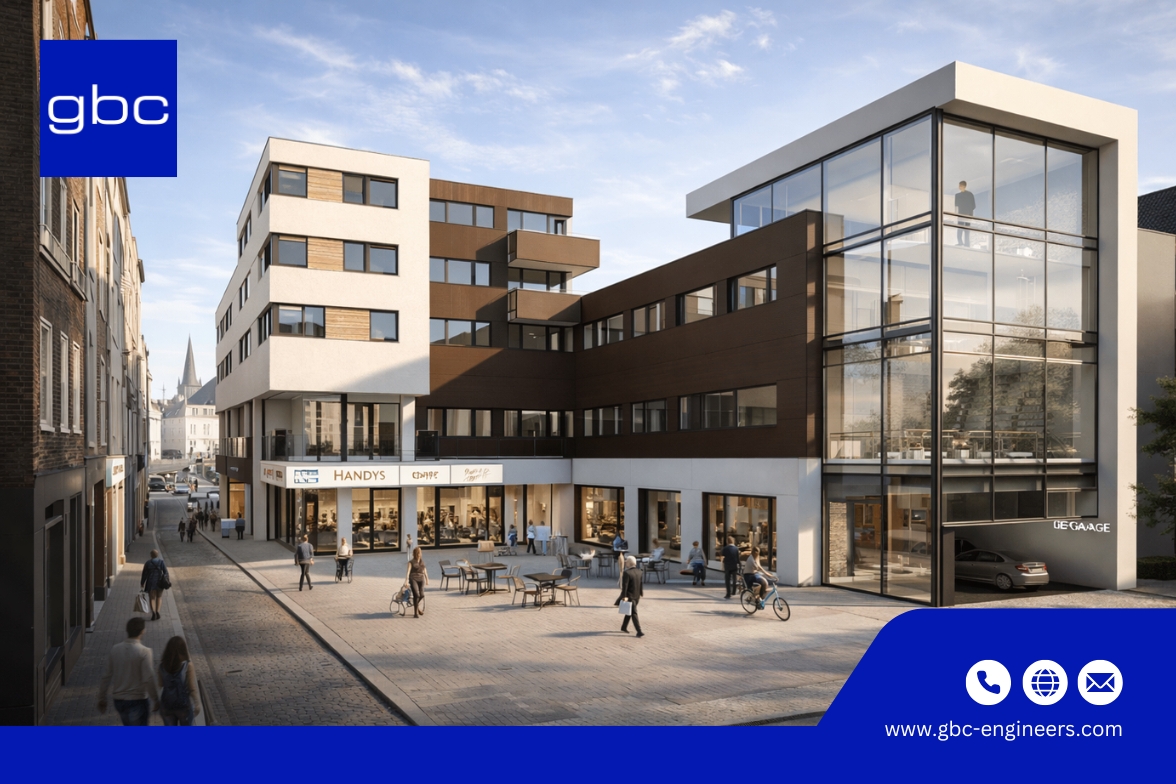
The Glatter Aal project in Rostock is a prime example of high-density vertical integration. The development combines residential units and a hotel across 6 upper floors, all sitting atop a massive three-level underground parking garage. The transition between the domestic scale of the upper floors and the wide spans required for the parking levels demanded a sophisticated transfer system and meticulous geotechnical coordination.
Why Asset Managers and Investors Seek Specialized Partners
Property developers often face a "technical gap" between a creative architectural concept and a buildable, profitable structure. A specialized structural partner acts as the technical guardian of the project, ensuring that the design is not only safe but also commercially viable.
Beyond the design phase, the role of the engineer extends to the construction site. To ensure that the "as-built" quality matches the design precision, we recommend comprehensive Construction Supervision. This is particularly vital in mixed-use projects where the installation of complex transfer structures and seismic bracing must be monitored with zero tolerance for error.
By partnering with a firm that understands the intricacies of global standards and local site conditions, developers can mitigate risk, accelerate timelines, and ensure that their landmark project is built on a foundation of engineered certainty.
Conclusion: Securing the Future of Urban Living
Mixed-use developments represent the future of our cities, but they are undeniably some of the most challenging structures to design and execute. The success of these projects depends on early involvement from a team that understands mixed-use structural complexity and can deliver integrated structural design solutions that protect the project's bottom line.
From optimizing load coordination to implementing "beyond code" comfort standards, specialized engineering is the invisible force that turns a complex building into a high-performing asset.
At gbc engineers, we bring a legacy of German precision and a forward-thinking approach to every project we touch. Whether you are navigating the complexities of a multi-level transfer system or seeking to optimize your building's carbon footprint, our team is dedicated to providing the clarity and technical excellence your development demands.
|
About us
gbc engineers
is an international engineering consultancy with offices in Germany, Poland, and South East Asia, having delivered 500+ projects worldwide. We provide services in structural engineering, data center design, infrastructure and bridge engineering, BIM & Scan-to-BIM, and construction management. Combining German engineering quality with international expertise, we achieve sustainable, safe, and efficient solutions for our clients.
|