Reviewed by Yoan Guyon, Managing Director at gbc engineers
Power Usage Effectiveness (PUE) has become the headline benchmark for data center energy efficiency. A PUE of 1.0 would mean that every watt drawn from the grid goes directly to Information Technology (IT) equipment, but real facilities always need additional energy for cooling, power distribution, lighting and controls. That is why a sustained PUE below 1.2 is ambitious, especially outside hyperscale campuses in cool climates.
In this article, gbc engineers explores how building physics, cooling design and operational choices shape real PUE performance. The goal is to help data center owners, engineers and decision makers understand what is technically achievable, what depends on the site, and where a lower PUE may increase the Initial Capital Expenditure (CapEx), Water Usage Effectiveness (WUE) or operational complexity.
What is Power Usage Effectiveness (PUE) in a data center?
PUE is the ratio of total facility energy to IT equipment energy. A PUE of 1.5 means that for every 1 watt used by IT equipment, another 0.5 watts are used by cooling, power distribution, lighting and other facility systems.
A PUE of 1.2 means only 0.2 watts of overhead for every watt of IT load. The formula is simple, but the design challenge behind it is not.
|
PUE = Total facility power ÷ IT equipment power
|
Uptime Institute reported an industry average PUE of approximately 1.56 in its 2024 Global Data Center Survey. The best performing facilities, mainly large hyperscale campuses with favorable climate conditions and high IT utilization, often operate closer to 1.1 to 1.2.
For enterprise and colocation projects, reaching that level requires more than efficient chillers. It requires a data center cooling design that coordinates site, building physics, power architecture, IT density and operations strategy.
|
|
|
|
|
|
|
Not achievable in practice
|
|
|
|
Best hyperscale campuses in ideal climates
|
|
|
|
Advanced colocation or liquid cooled facilities
|
|
|
|
Modern well designed data centers
|
|
|
|
Typical enterprise data centers
|
|
|
|
Older facilities or sites with poor airflow control
|
Why building physics sets the baseline for data center PUE
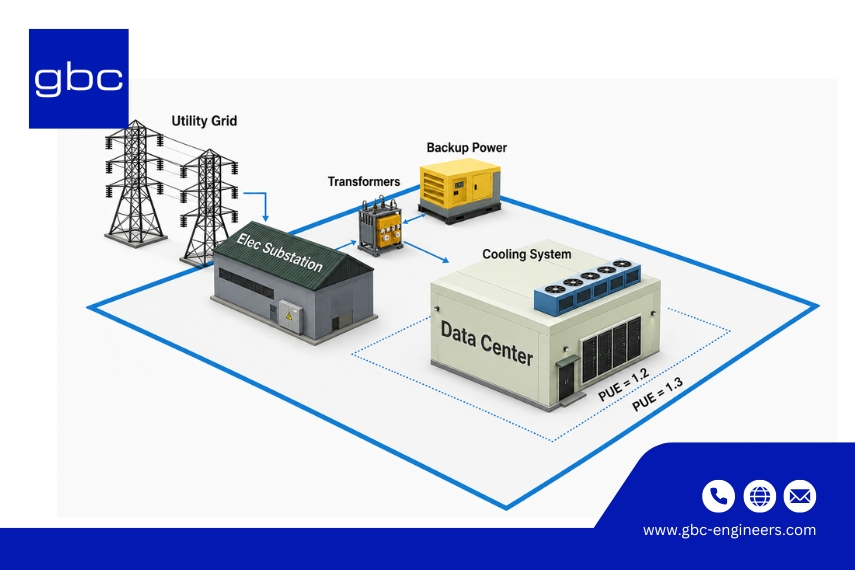
Before a data center cooling system is selected, the building envelope, climate, thermal mass and airflow strategy already define much of the PUE potential.
Climate conditions and data center PUE improvement
Climate is one of the strongest variables in data center PUE improvement. Facilities in northern Europe, Scandinavia or cold North American regions can use ambient air or water-side free cooling for many hours each year, which sharply reduces compressor energy.
A similar data center in a hot and humid region may have far fewer economizer hours. This does not make low PUE impossible, but it usually requires higher CapEx, liquid cooling, more careful heat rejection design or a different performance target.
American Society of Heating, Refrigerating and Air-Conditioning Engineers (ASHRAE) environmental classes also matter. Where IT equipment can safely operate within wider temperature and humidity ranges, the cooling plant can run at higher temperatures and use free cooling more often.
Building physics and internal heat gains in data center cooling design
Heat from lighting, Uninterruptible Power Supply (UPS) losses, transformers, power distribution equipment and the building fabric all adds to the cooling load. Every watt that is not IT load but still requires cooling directly worsens PUE. Roof insulation, glazing area and solar exposure rarely dominate the PUE picture, but they become important when the target is below 1.2, where small inefficiencies accumulate.
Airflow management for data center cooling efficiency
Poor airflow management can destroy the efficiency of even a well-selected cooling plant. Hot aisle and cold aisle containment, blanking panels, sealed floor penetrations and controlled return air paths all reduce mixing between supply air and hot exhaust air.
For any serious PUE target, airflow management is a design requirement.
Read more: Data Center Cooling: How Modern Systems Improve Efficiency and Sustainability
Which data center cooling design strategies can drive PUE below 1.2?
Cooling design determines how efficiently heat can be removed. The best strategy depends on local climate, rack density, redundancy requirements and the CapEx that the project can justify.
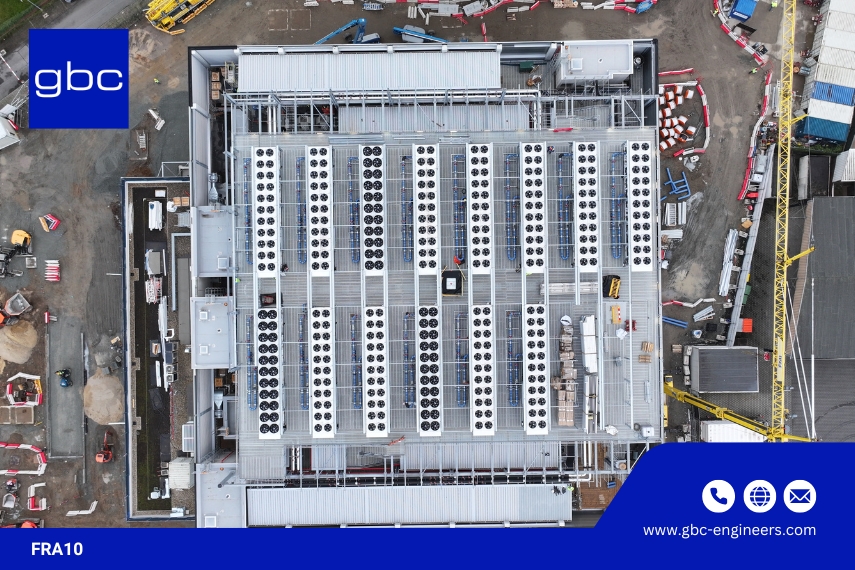
Air side economizer cooling for data center cooling design
Air side economizer cooling uses outdoor air directly to cool the IT space when temperature and humidity are suitable. In cool and dry climates, this is one of the strongest strategies for reaching low PUE values.
Hyperscale facilities in northern Europe using direct fresh air cooling regularly report annual average PUE values between 1.03 and 1.12, with some sites consistently below 1.1.
The tradeoff is air quality management. Filtration, humidity control, smoke events and particulate contamination must all be considered. For urban sites or polluted regions, the filtration burden can reduce part of the energy benefit.
Water side economizer cooling and free cooling for data centers
Water side economizer cooling uses cooling towers, dry coolers or fluid coolers to reject heat without running mechanical compression whenever outdoor conditions allow. It is often more practical than direct outdoor air, where air quality is a concern.
The key question is not only PUE. Evaporative cooling can improve energy efficiency but increase Water Usage Effectiveness (WUE). In water stressed regions, a slightly higher PUE with much lower water use may be the more responsible engineering choice.
Higher chilled water supply temperatures in data center cooling systems
Chiller efficiency improves when the chilled water supply temperature is higher. Traditional chilled water plants typically supply water at 6 to 8 degrees Celsius to CRAC or CRAH units.
Raising the chilled water supply temperature to 14 to 18 degrees Celsius reduces the temperature difference that the chiller must maintain. This cuts compressor energy and extends the number of hours when dry coolers or fluid coolers can reject heat without mechanical assistance.
Direct liquid cooling and immersion cooling PUE
Liquid cooling removes heat closer to the source. Direct liquid cooling transfers heat from chips into a fluid loop via cold plates, while immersion cooling submerges server boards in dielectric fluid. Both methods reduce fan energy and support higher coolant supply temperatures.
For artificial intelligence (AI) and high-density computing, liquid cooling converts an airflow problem into a heat rejection problem, which is easier to solve efficiently.
PUE values achievable with each liquid cooling approach are summarized in the comparison table below. An immersion cooling data center may also reduce process water demand if it avoids evaporative cooling, though the business case depends on rack density, fluid management and CapEx.
Cooling technology comparison for PUE impact
|
Cooling strategy
|
Typical PUE range
|
Key dependency
|
|
Traditional CRAC or CRAH with chiller
|
1.4 to 1.8
|
Chiller efficiency, climate, airflow discipline
|
|
Chiller with water-side economizer
|
1.2 to 1.5
|
Outdoor wet-bulb temperature and cooling tower strategy
|
|
Air-side economizer in cool climate
|
1.03 to 1.12
|
Ambient air quality and climate zone
|
|
Direct liquid cooling with warm-water rejection
|
1.03 to 1.15
|
Chilled water supply temperature, heat rejection loop and proportion of load liquid cooled
|
|
Single-phase immersion cooling
|
1.02 to 1.10
|
Fluid management, heat rejection loop and proportion of non-immersed load
|
|
Two-phase immersion cooling
|
1.02 to 1.08
|
Sealed system design, fluid selection, climate and heat rejection
|
Read more: Air vs Liquid Cooling in Data Centers: When Should You Make the Switch?
What prevents a data center from reaching PUE below 1.2?
Most facilities miss a sub-1.2 PUE because of site constraints, partial load operation and business requirements, not a lack of available technology. Understanding these constraints early prevents unrealistic targets.
Power distribution losses in data center PUE
Transformers, UPS systems, power distribution units and switchgear introduce losses between the utility connection and IT equipment. Those losses become heat, which then increases the cooling load.
Modern high-efficiency UPS systems can reduce this penalty, but operating modes must be selected carefully. ECO mode can improve efficiency, while some operators avoid it because of transfer time or resilience concerns.
Partial load operation and data center PUE
PUE often looks worse when IT load is low. Facility overheads remain active while the IT equipment uses only part of the installed capacity. A data center at 30 percent of its design IT load can measure a much higher PUE than the same site at mature occupancy, even when all systems are correctly designed and operating.
Modular build strategies address this directly. Cooling and power systems should scale with the IT load instead of forcing the project to carry too much unused overhead during the ramp-up phase.
Redundancy requirements and Power Usage Effectiveness
Redundancy improves reliability but can reduce PUE. A 2N architecture has more installed cooling and power capacity than an N+1 system, and standby systems still consume energy through control power, pump cycling and maintenance operation.
The answer is to design redundant systems that remain efficient at partial load, and to set PUE targets that reflect the availability tier.
Poor airflow containment in data center cooling systems
Bypass airflow, recirculation and hot-to-cold air mixing are common reasons why efficient cooling equipment underperforms. This problem is often cheaper to solve than a major plant replacement, especially in existing facilities.
For many operators, improving containment, sealing gaps and optimizing fan control is the most cost-effective first step.
Practical design checklist for data center PUE improvement
For teams targeting PUE below 1.2, these design topics should be reviewed early, before key design decisions are locked in.
Site and climate assessment for data center cooling design
- Confirm annual dry bulb and wet bulb temperature profiles for the site.
- Calculate available free cooling hours at candidate chilled water supply temperatures.
- Assess outdoor air quality for direct fresh air-cooling feasibility.
- Review water availability and local restrictions on evaporative cooling.
- Coordinate structural layout with airflow paths, plant rooms and heat rejection equipment.
- Plan full hot aisle or cold aisle containment from day one.
- Minimize glazing in IT areas and use high-performance glazing where required.
- Specify roof and wall insulation that limits solar and conductive heat gains.
Data center cooling and power system design
- Target chilled water supply temperatures of 14 to 18 degrees Celsius where IT equipment specifications and containment design allow.
- Use plate heat exchangers, dry coolers or water-side economizers where climate supports them.
- Consider direct liquid cooling for AI or HPC racks approaching or exceeding the air-cooling limit, typically 20 to 30 kW per rack for conventional air systems and up to 30 to 40 kW for in-row or overhead precision cooling.
- Evaluate single-phase immersion cooling for sustained rack densities above 40 to 60 kW, and two-phase immersion for extreme densities above 80 to 100 kW.
- Design the heat rejection loop for heat reuse where nearby users or district systems exist.
How PUE, WUE, CUE and ERF shape sustainability
PUE is one of several sustainability metrics that matter. WUE measures water consumption per unit of IT energy. Carbon Usage Effectiveness (CUE) adds the carbon intensity of the energy supply. Energy Reuse Factor (ERF) measures whether recovered heat is being used productively. These metrics can pull in different directions: evaporative cooling may reduce PUE while raising WUE and closed-loop liquid cooling may use slightly more electrical energy in some climates but reduce water consumption and improve heat reuse potential. The right balance depends on the local energy mix, water availability and whether district systems can use recovered heat.
The European Union (EU) Energy Efficiency Directive and Commission Delegated Regulation (EU) 2024/1364 require data center operators to report energy performance and water consumption transparently. For projects in Europe, cooling design should therefore be judged against a broader set of sustainability outcomes.
Read more: Direct-to-Chip vs Immersion Cooling: Which Liquid Cooling System Is Right for Your Data Center?
Is PUE below 1.2 the right target for your data center project?
The target should come from the engineering analysis, not from a headline benchmark copied from a hyperscale campus.
When PUE below 1.2 is realistic for a data center
- The site has a cool temperate climate with strong economizer availability.
- IT utilization is high and consistent across the facility.
- High density or liquid cooled racks allow warm water heat rejection.
- Redundancy is carefully designed for efficient partial load operation.
- Power distribution losses are minimized through modern system architecture.
When PUE below 1.2 is difficult to sustain
- The site is hot or humid with limited free cooling hours.
- The facility requires high redundancy, especially 2N architecture.
- IT load is low during a long ramp-up phase.
- The building envelope has high heat gain or poor airflow discipline.
- Air-only cooling is used for high rack densities that need low supply temperatures.
When hybrid data center cooling design closes the PUE gap
Some projects may not achieve PUE below 1.2 across the whole facility, but they can achieve it in specific high-density zones. A liquid-cooled AI compute pod can operate at much lower PUE than the general-purpose area of the same campus, improving efficiency where the heat load justifies the investment without committing unnecessary CapEx across lower-density areas.
Conclusion
PUE below 1.2 is achievable, but it is not a product specification. It is the result of aligned decisions across site selection, building physics and cooling design. gbc engineers hopes this article has clarified the engineering decisions behind a realistic PUE target.
The most important step is to assess PUE potential early, using real climate data, realistic load profiles and accurate system efficiency curves. If your team is reviewing a data center cooling system, PUE target or energy efficiency strategy, gbc engineers can support that assessment.
Frequently asked questions
Can a data center achieve PUE below 1.1?
Yes, but it is usually limited to large hyperscale facilities in favorable climates, using air-side economization or advanced liquid cooling with high IT utilization. Google, Meta and Microsoft have published annual PUE figures below 1.1 for some of their northern European campuses. For most enterprise and colocation sites, a sustained PUE below 1.1 is difficult to achieve given typical redundancy requirements and climate conditions.
How does liquid cooling improve PUE?
Liquid cooling removes heat closer to the source, which reduces fan energy and enables higher coolant temperatures. This increases the availability of economizer operation and can support lower PUE values, especially in high-density AI and HPC environments. Direct-to-chip systems can allow heat rejection at 30 to 45 degrees Celsius, while immersion cooling can reduce or remove server fan energy in dense configurations.
Does redundancy affect PUE?
Yes, significantly. A 2N design results in a higher measured PUE than an N+1 design because standby systems consume control power, undergo maintenance cycles and add thermal load. PUE targets should always account for the chosen redundancy tier.
What role does climate play in low PUE performance?
Climate determines how often a facility can use air-side or water-side free cooling. In northern Europe, air-side economization can operate for 7,000 or more hours per year; in tropical climates, the same approach may offer only a few hundred usable hours annually.
What is a realistic PUE target for a new data center in a temperate climate?
For a new data center in a temperate European climate with full containment, modern high-efficiency power distribution and a well-designed water-side economizer strategy, a sustained annual average PUE of 1.15 to 1.25 is achievable. Values below 1.15 are possible when direct liquid cooling is used for high-density zones and the heat rejection loop is designed for economizer-first operation.
|
About us
gbc engineers
is an international engineering consultancy with offices in Germany, Poland, and South East Asia, having delivered 500+ projects worldwide. We provide services in structural engineering, data center design, infrastructure and bridge engineering, BIM & Scan-to-BIM, and construction management. Combining German engineering quality with international expertise, we achieve sustainable, safe, and efficient solutions for our clients.
|