The world’s largest data centers in 2026 are being shaped by one force above all others: AI. As cloud providers and technology companies race to build infrastructure for the next generation of AI models, the scale of new facilities has jumped from hundreds of megawatts to the gigawatt range in just a few years.
Let’s explore with gbc engineers the top 5 largest data centers in the world, ranked by IT load capacity (MW) and how they are shaping the future through innovative engineering and structural solutions.
|
#
|
Facility
|
Location
|
Operator(s)
|
IT Capacity
|
Status
|
|
1
|
China Telecom-Inner Mongolia Information Park
|
China
|
China Mobile, Alibaba, ByteDance + others
|
~3,000+ MW
|
Operational
|
|
2
|
The Citadel Campus
|
Nevada, USA
|
Switch / DigitalBridge
|
~650 MW
|
Operational
|
|
3
|
Stargate — Abilene Campus
|
Texas, USA
|
OpenAI / Oracle / SoftBank
|
~400–500 MW
|
Under construction
|
|
4
|
Maiden NC Cluster
|
North Carolina, USA
|
Apple + Google
|
~400–500 MW
|
Operational
|
|
5
|
Singapore / Johor Cluster
|
SG + Malaysia
|
AWS, Google, Microsoft + others
|
~350–500 MW
|
Operational
|
1. China Telecom-Inner Mongolia Information Park (~3,000+ MW)
|
Location
|
Hohhot & Ulanqab, Inner Mongolia, China
|
|
IT Capacity
|
~3,000+ MW (combined cluster)
|
|
Operator(s)
|
China Mobile, China Telecom, Alibaba Cloud, ByteDance, Baidu, Tencent
|
|
Status
|
Operational hyperscale cluster
|
|
Energy / Cooling Profile
|
Average annual temperature ~4–6°C; free-air cooling available 8,000+ hrs/year; low energy costs; 80+ GW installed wind capacity
|
|
Key Engineering Consideration
|
Free-air cooling and high-density layouts shift structural demand toward slab capacity, overhead services, cable trays, ductwork, busways, and hot/cold aisle geometry.
|
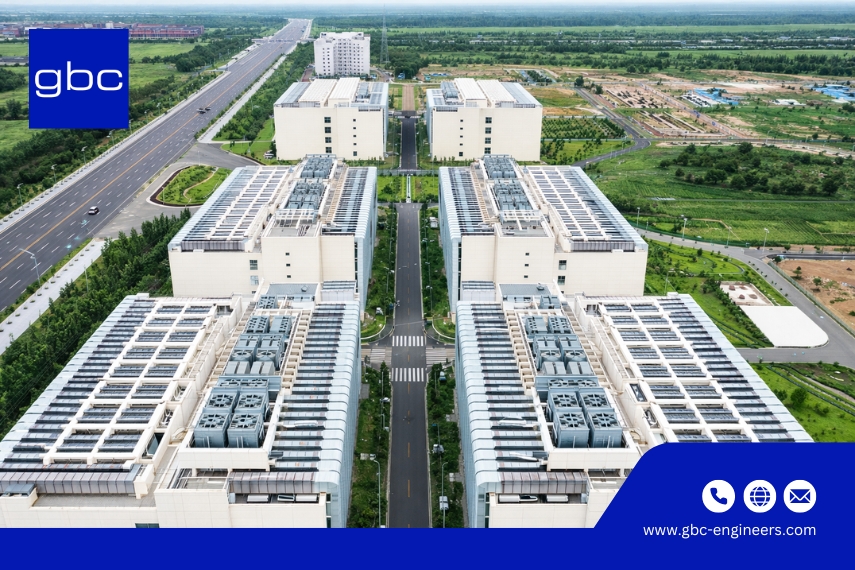
No single location on earth hosts more hyperscale IT capacity than Inner Mongolia. The Hohhot–Ulanqab corridor is home to purpose-built hyperscale campuses from every major Chinese technology company — each drawn by the same convergence: near-freezing average temperatures that dramatically reduce mechanical cooling demand, China’s most competitively priced electricity, and direct policy backing from Beijing’s “East Data, West Computing” (东数西算) initiative.
China Mobile’s Ulanqab hub alone targets 500–600 MW at full build-out. Add the campuses from Alibaba Cloud, ByteDance, Baidu, Tencent, and China Telecom, and the cluster comfortably exceeds 3,000 MW — more than four times the next largest single campus on this list.
From a structural standpoint, free-air cooling at this scale reshapes building design significantly. Without raised floors for underfloor air distribution, structural slabs must accommodate overhead cooling distribution — increasing suspended load requirements from cable trays, ductwork, and busways. Column grids are optimised not only for IT equipment loads (typically 10–20 kN per rack position) but also for the airflow management geometry of hot and cold aisle containment systems at high row density.
Read more: Typical Data Center Layout: Core Components and Infrastructure 2026
2. The Citadel Campus — Nevada, USA (~650 MW)
|
Location
|
Tahoe Reno Industrial Center, Storey County, Nevada, USA
|
|
IT Capacity
|
~650 MW at full build-out (operator-published figure)
|
|
Operator(s)
|
Switch Inc. / DigitalBridge Group
|
|
Status
|
Operational; phased campus build-out
|
|
Energy / Cooling Profile
|
100% renewable energy through Nevada solar and geothermal PPAs
|
|
Key Engineering Consideration
|
Large-scale backup generators, UPS rooms, MV switchgear, and transformer bays create significant structural loads; modular pod design supports phased capacity delivery.
|
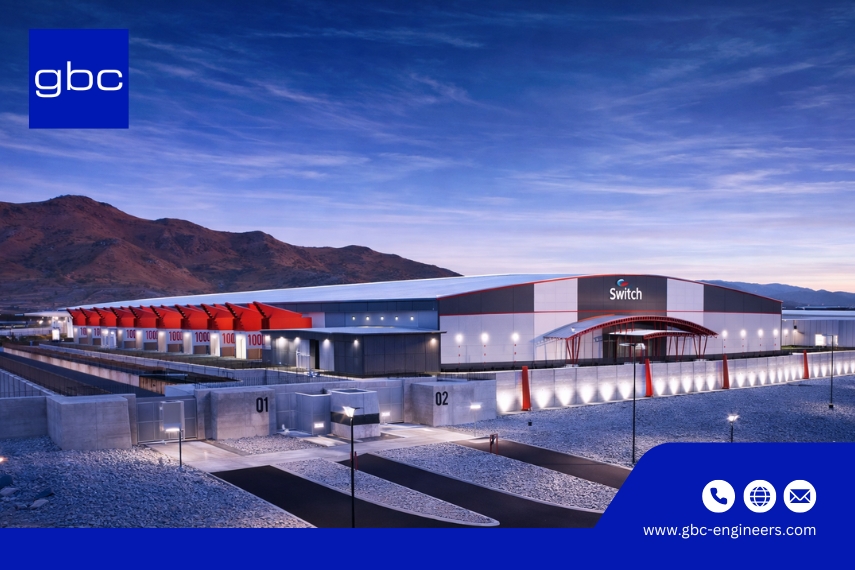
The Citadel is the largest single data center campus in the world with a directly operator-published IT load capacity figure. Switch’s stated 650 MW full build-out target makes it the most reliably cited single-campus benchmark in global data center rankings.
DigitalBridge acquired Switch in October 2022 for approximately USD 11 billion — one of the most significant infrastructure acquisitions in the sector’s history. The campus operates on 100% renewable energy and is built to Switch’s proprietary SUPERNAP® standard, which meets or exceeds Uptime Institute Tier IV for fault tolerance.
Delivering 650 MW of IT load capacity from a single campus demands a power infrastructure of considerable structural weight. Diesel generator sets for full-campus backup power alone — typically rated at 2–4 MVA per unit — can represent several hundred units across a facility of this scale, each weighing 15,000–30,000 kg. UPS battery rooms, MV switchgear halls, and transformer bays collectively impose area loads of 15–25 kN/m² or more. Switch’s modular pod design manages this by distributing structural load incrementally across phased construction, allowing the building structure to be engineered for actual delivered capacity rather than full build-out from day one.
Read more: Precast Hollow Core Slabs for Data Centers
3. Stargate — Abilene, Texas, USA (~400–500 MW)
|
Location
|
Abilene, Taylor County, Texas, USA
|
|
IT Capacity
|
~400–500 MW (Phase 1 announced IT capacity)
|
|
Operator(s)
|
OpenAI, Oracle, SoftBank (Stargate LLC, announced Jan 21, 2025)
|
|
Status
|
Under construction; first buildings targeted H2 2025
|
|
Energy / Cooling Profile
|
AI-focused campus requiring high-capacity power infrastructure and direct liquid cooling for NVIDIA GB200 NVL72 systems (~120 kW/rack)
|
|
Key Engineering Consideration
|
AI rack densities of 40–120 kW shift design priorities toward liquid-cooling distribution, point-load control, floor vibration performance, and power-room structural capacity.
|
Announced by OpenAI, Oracle, and SoftBank on January 21, 2025 with a White House announcement — Stargate is the largest AI infrastructure program ever committed to. The Abilene campus is its first and flagship site, targeting 400–500 MW of IT capacity specifically built for frontier AI model training.
At 120 kW per rack, the NVIDIA GB200 NVL72 systems deployed here run at 6–12x the density of standard enterprise racks. The full Stargate national program targets up to 5 GW across approximately 20 U.S. locations — a figure that would reshape the entire U.S. data center landscape if delivered.
4. Maiden, NC Cluster — North Carolina, USA (~400–500 MW)
|
Location
|
Maiden, Catawba County, North Carolina, USA
|
|
IT Capacity
|
~400–500 MW combined (Apple + Google)
|
|
Operator(s)
|
Apple + Google
|
|
Status
|
Operational; continued expansion through Apple and Google campus development
|
|
Energy / Cooling Profile
|
Duke Energy Carolinas utility supply; Apple uses 100% renewable energy via on-site solar and PPAs; Google uses 100% renewable matching
|
|
Key Engineering Consideration
|
Independent utility and planning records make capacity verification stronger; campus expansion requires long-term planning for power distribution, site infrastructure, and future structural capacity.
|
Maiden is one of the least-publicised entries on this list and one of the most credible. Apple established its first purpose-built data center here in 2012, followed by a major Google campus. Together they have made Catawba County home to one of the highest concentrations of hyperscale IT capacity on the U.S. East Coast.
What distinguishes Maiden for ranking purposes is source quality: capacity figures are drawn from Duke Energy utility connection filings and Catawba County planning commission records — independent government documents entirely outside operator control. That makes this the most independently verified entry in the top 5.
5. Singapore / Johor Cluster — Southeast Asia (~350–500 MW operational)
|
Location
|
Singapore + Johor Bahru, Malaysia
|
|
IT Capacity
|
~350–500 MW operational; 1,000+ MW announced / under construction
|
|
Operator(s)
|
AWS, Google Cloud, Microsoft Azure, Equinix, Digital Realty, GDS, ST Telemedia
|
|
Status
|
Operational regional cluster with major capacity under construction
|
|
Energy / Cooling Profile
|
Singapore requires IT PUE ≤1.3 for new data centers, 100% renewable energy, and seismic design per SS EN 1998:2021; Johor provides land and power capacity
|
|
Key Engineering Consideration
|
Dense urban constraints in Singapore and fast-scale campus development in Johor increase the importance of modular planning, grid readiness, seismic design, and constructability review.
|
The Singapore–Johor corridor is Southeast Asia’s data center capital — and the fastest-growing major cluster in the world right now. Singapore anchors the region with over 20 international submarine cable systems and strict sustainability standards (PUE ≤1.3 for all new facilities). Johor, just across the Causeway, offers the land and power capacity Singapore can’t.
Over USD 30 billion in data center investment has been announced for Johor alone since 2023, from Microsoft, Google, Oracle, ByteDance, and others. The operational cluster sits at 350–500 MW today, with more than 1,000 MW in the construction pipeline — making this the #5 entry today and a serious contender for higher in the next ranking cycle.
Read more: What Are the Real Challenges to Design a Data Center?
What’s driving the next generation of hyperscale data centers
1. AI is rewriting the rules
The hyperscale build-out of the past decade was driven by cloud storage and streaming. The next wave is AI — and the numbers are in a different league. AWS, Microsoft, Google, and Meta collectively committed over USD 300 billion in data center CapEx for 2025 alone. GPU clusters now run at 40–120 kW per rack, making liquid cooling standard rather than optional.
2. Southeast Asia is the fastest-growing market
Investment is pouring into Malaysia (Johor), Indonesia, Thailand, and the Philippines at a pace that would have seemed impossible five years ago. Johor has attracted over USD 30 billion in announced data center investment since 2023. Singapore’s strict PUE ≤1.3 rule and seismic design requirements under SS EN 1998:2021 are setting a high bar for the region’s entire market.
3. Nuclear and SMRs on the horizon
The power demands of AI data centers are so large that solar and wind alone can’t always meet them on a 24/7 basis. Oracle, Microsoft, and Amazon are all actively exploring Small Modular Reactors (SMRs) and advanced nuclear agreements to secure reliable, carbon-free power for their largest campuses.
Ready to Future-Proof Your Data Center?
Partner with gbc engineers to design a facility that delivers performance, reliability, and long-term value.
🌐 Visit: www.gbc-engineers.com
🏗️ Explore Our Services: Services — gbc engineers
Conclusion
The top 5 largest data centers in the world in 2026 are no longer just about storage and cloud computing — they are AI infrastructure at national scale. China leads by cluster capacity. The U.S. leads in large single-campus verified figures. Southeast Asia is growing faster than anywhere else.
For project owners, investors, and operators, this means data center planning is becoming more demanding and more strategic. Facilities need to be built not only for current performance, but also for future expansion, operational reliability, and increasingly complex technical requirements.
At gbc engineers, we support this transformation with structural and civil engineering expertise for data center projects across Europe and Southeast Asia. By combining load-bearing structural design knowledge, civil engineering coordination, and practical project experience, we help clients deliver data center facilities that are efficient, scalable, and ready for long-term growth.
Frequently Asked Questions
What is the largest data center in the world in 2026?
By IT load capacity, the Inner Mongolia Hyperscale Cluster in China is the world’s largest, with approximately 3,000+ MW of combined capacity across multiple operators including China Mobile, Alibaba Cloud, ByteDance, and China Telecom. The largest single named campus with an operator-published figure is The Citadel Campus in Nevada, USA (~650 MW, Switch / DigitalBridge).
How is data center size measured correctly?
IT load capacity in megawatts (MW) is the correct metric — it measures how much power is delivered to actual computing equipment. Floor area (m² or ft²) only measures building size and is not comparable across facilities with different rack densities. MW is the standard used by all major industry analysts including DCD, JLL, and CBRE.
Why does the ranking include clusters and not just single campuses?
The world’s highest IT capacity concentrations — particularly in China and Southeast Asia — are clusters of separately owned campuses within the same geographic zone. Excluding them would leave the ranking incomplete. All cluster entries are clearly labelled and aggregated from multiple independently verified sources.
Is Stargate the biggest data center in the world?
Not yet. Stargate’s full program targets up to 5 GW across approximately 20 U.S. sites, which would make it the largest national AI infrastructure program ever built. However, Phase 1 at Abilene targets 400–500 MW — significant but not yet the world’s largest. Construction was ongoing as of mid-2025.
Why is Southeast Asia important for data center growth?
Southeast Asia has 680 million internet users and one of the world’s fastest-growing digital economies. The Singapore–Johor corridor is the region’s data center hub, with over USD 30 billion in announced investment in Johor alone since 2023. Singapore’s strict PUE and renewable energy requirements are setting standards for the whole region.
|
About us
gbc engineers
is an international engineering consultancy with offices in Germany, Poland, and South East Asia, having delivered 500+ projects worldwide. We provide services in structural engineering, data center design, infrastructure and bridge engineering, BIM & Scan-to-BIM, and construction management. Combining German engineering quality with international expertise, we achieve sustainable, safe, and efficient solutions for our clients.
|